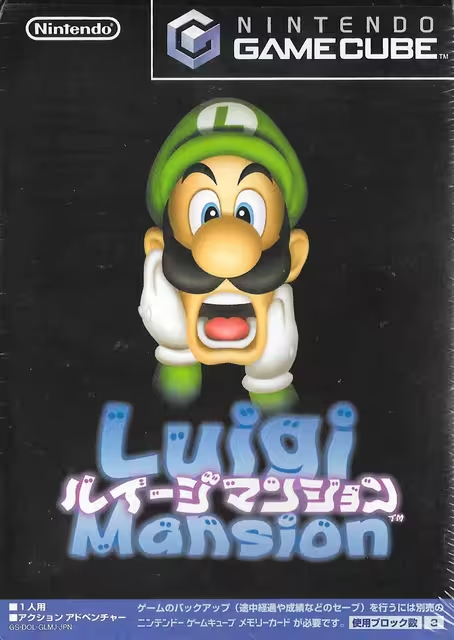
Luigi Mansion
DOL-GLMJ-JPN
Video Game Collection


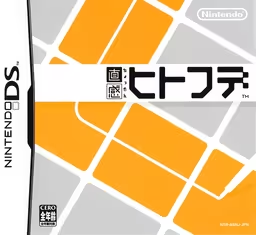 Front Cover
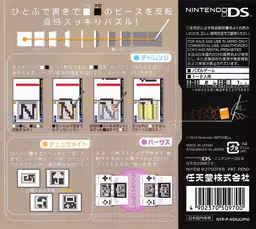 Back Cover
A stylus‑driven puzzle game for Nintendo DS, released internationally as Polarium, where players flipped black and white tiles by tracing continuous lines to clear rows.
Chokkan Hitofude was part of the DS launch lineup in Japan. Its central mechanic revolved around drawing a single unbroken line across a grid of black and white tiles on the touchscreen. Every tile touched by the line flipped colour, and the objective was to create complete horizontal rows of uniform colour, which would then clear from the board.
The game offered two main modes. Challenge Mode functioned like a falling‑block puzzle, with new rows of tiles dropping from above. Players had to quickly trace efficient paths to clear lines before the stack reached the top, echoing the pressure of Tetris but with a very different logic. Puzzle Mode (called Checkmate in some versions) presented static arrangements of tiles that had to be solved in a single stroke, often forming pictures or intricate patterns. This mode included 100 built‑in puzzles and a creation tool that allowed players to design and share their own, either via password codes or local wireless transfer.
The minimalism of black and white tiles accented with clean interface design emphasised clarity and precision. Scoring rewarded not just survival but efficiency, with bonuses for clearing multiple lines in one stroke, chaining solutions, or creating complex patterns. The stylus input was central to the experience, showcasing the DS’s touchscreen as a platform for puzzle innovation. Internationally, the game was retitled Polarium and released in 2005 across Europe, North America, and Australia. It was later followed by a Game Boy Advance sequel, Tsuukin Hitofude (Polarium Advance), which expanded the puzzle set and refined the mechanics.
The games highlights are its conceptual originality and the elegance of its design, though some criticised the steep difficulty curve in Challenge Mode. Despite its niche appeal, Chokkan Hitofude remains a notable example of early DS experimentation, demonstrating how the touchscreen could enable puzzle mechanics impossible on traditional consoles.
| Item Name |
|
|---|---|
| Original Name |
|
| Item Code |
|
| Item Number |
|
| Type | |
| Genre | |
| Characteristics | |
| Region | |
| Territory | |
| Packaging | |
| Documentation | |
| Developer | |
| Publisher | |
| Media | |
| Players | |
| Classification | |
| Release Date | |
| Date Added |
|
| External Links |
|