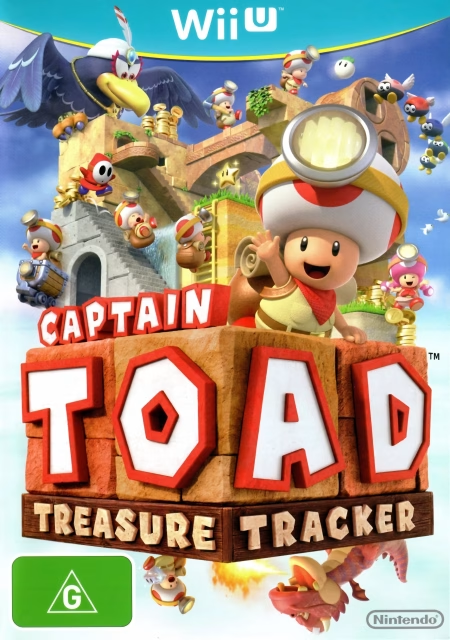
Captain Toad: Treasure Tracker
WUP-AKBP-AUS
Video Game Collection

Super Fami port of the original Puyo Puyo.
Super Puyo Puyo distinguished itself from other puzzle games of its era by emphasising competitive depth over solitary play. Unlike Tetris, which focused on spatial efficiency and endurance, or Dr. Mario, which leaned into pattern recognition with a fixed grid, Puyo Puyo introduced a dynamic chaining system that rewarded foresight, timing, and disruption. Its versus mode was central to its appeal, turning puzzle-solving into a tactical duel where players could offset incoming garbage and manipulate chain reactions to overwhelm opponents. This emphasis on interaction and counterplay set it apart from contemporaries like Columns or Bust-A-Move, which offered less reactive multiplayer mechanics.
Although this game was initially Japan-exclusive, it was indirectly released to western audiences. Both major platforms adapted the game using their existing IP. On Sega, it was adapted as Dr. Robotnik’s Mean Bean Machine and on Nintendo as Kirby’s Avalanche/Kirby’s Ghost Trap.
The Puyo Puyo series’ legacy is substantial. Originating as a spin-off of Compile’s Madō Monogatari RPGs, Puyo Puyo evolved into one of Japan’s most enduring puzzle franchises. Its chaining and offsetting mechanics became genre-defining, influencing later titles such as Super Puzzle Fighter II Turbo and Panel de Pon. After Sega acquired the rights in 1998, the series expanded internationally through rebranded versions and crossover titles like Puyo Puyo Tetris. Today, Puyo Puyo is recognized not just for its mechanical elegance, but for sustaining a competitive scene and inspiring a lineage of character-driven puzzle games that blend strategic depth with accessible design.
| Item Name |
|
|---|---|
| Original Name |
|
| Item Code |
|
| Item Number |
|
| Series | |
| Type | |
| Genre | |
| Theme | |
| Region | |
| Territory | |
| Packaging | |
| Documentation | |
| Developer | |
| Publisher | |
| Media | |
| Players | |
| Launch Price |
|
| Release Date | |
| Date Added |
|