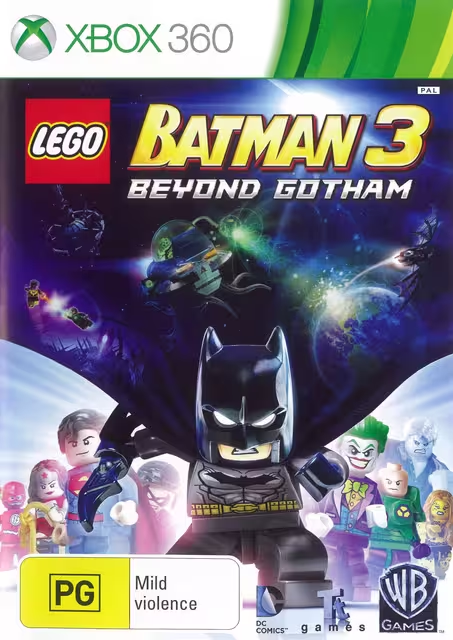
LEGO Batman 3: Beyond Gotham
361-95109
Collection de jeux vidéo

Un titre précurseur du monde ouvert, aussi ambitieux que profondément imparfait, qui tentait de simuler une Gotham City en temps réel rythmée par des attaques planifiées. Bien que massacré par la critique de l’époque pour sa jouabilité punitive, sa caméra chaotique et sa progression obscure, il est aujourd’hui reconnu comme un échec conceptuel visionnaire ayant tenté d’imposer des mécaniques de sandbox moderne sur une console 32 bits.
Batman & Robin est un jeu d’action-aventure adapté du film de 1997, largement décrié à sa sortie mais notable pour sa structure d’une ambition démesurée. Loin d’être un beat-’em-up linéaire classique, le titre s’apparente à un précurseur des jeux en monde ouvert. Les joueurs peuvent incarner Batman, Robin ou Batgirl, chacun disposant de son propre véhicule : la Batmobile, la moto Redbird ou le Batblade. Gotham City est modélisée comme un environnement 3D complet fonctionnant selon une horloge en temps réel. Les crimes et événements, comme une attaque de Mister Freeze sur une bijouterie, surviennent à des heures précises. Le joueur doit mener l’enquête, surveiller le Bat-ordinateur et traverser la ville pour intercepter les antagonistes avant qu’ils n’atteignent leurs objectifs.
À sa sortie, le titre a été démoli par la critique. Si quelques journalistes ont salué l’audace technique consistant à créer une Gotham vivante sur une architecture 32 bits, l’exécution a été quasi unanimement condamnée. Le système de commandes était notoirement complexe, exigeant des combinaisons de touches alambiquées pour des actions de base. Les critiques ont fustigé la lourdeur du déplacement façon « tank », une caméra restrictive occultant fréquemment l’action, ainsi qu’une difficulté brutale exacerbée par le système de temps réel, entraînant souvent l’échec des missions à cause de la topographie labyrinthique et embrumée de la ville.
Avec le recul, Batman & Robin occupe une place singulière, associée à une démesure technologique fascinante. Les joueurs modernes reconnaissent en lui une œuvre en avance sur son époque, tentant de bâtir une simulation de super-héros systémique bien avant que le matériel ou les standards de contrôle analogiques ne permettent une telle vision. S’il demeure frustrant à manipuler en raison de ses mécaniques archaïques et de son manque de guidage, il est régulièrement cité comme un chaînon manquant étrange, préfigurant conceptuellement la structure des jeux bac à sable modernes, tels que la franchise Batman: Arkham.
| Nom de l'article |
|
|---|---|
| Code article |
|
| Numéro d'article |
|
| Série | |
| Type | |
| Genre | |
| Thème | |
| Région | |
| Territoire | |
| Emballage | |
| Documentation | |
| Développeur | |
| Éditeur | |
| Support | |
| Joueurs | |
| Périphériques | |
| Classification par âge | |
| Date de sortie | |
| Date d'ajout |
|