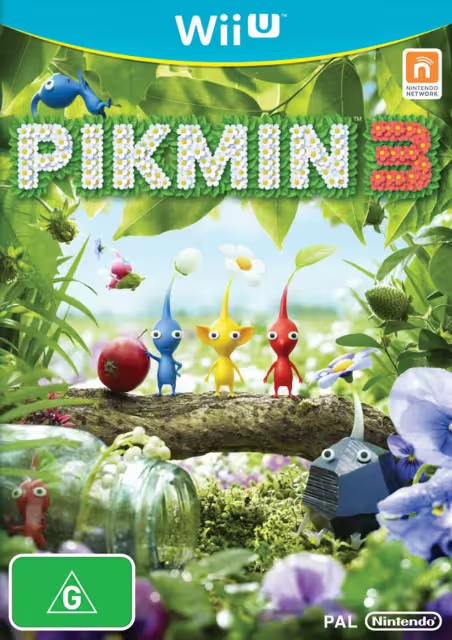
Pikmin 3
WUP-AC3P-AUS
Video Game Collection

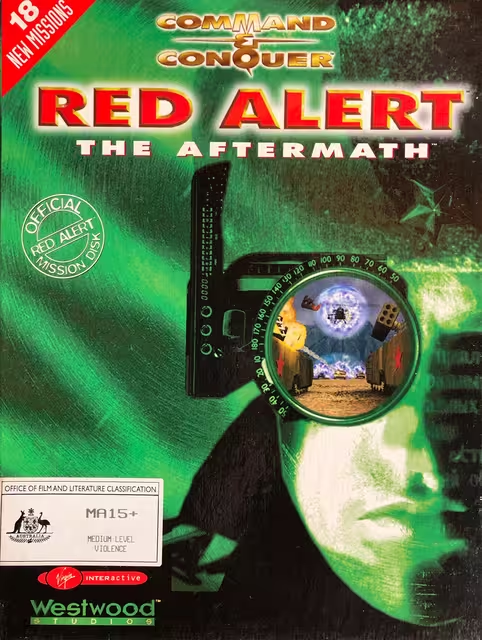
A real‑time strategy game that quickly became one of the most influential titles of its era. This Collector’s Edition contains the game, CD soundtrack, t-shirt, and poster.
Command & Conquer: Red Alert is set in an alternate history where Albert Einstein travels back in time to eliminate Hitler, inadvertently leaving Joseph Stalin free to expand Soviet power unchecked. This premise creates the central conflict between the Allies and Soviets, fought across Europe with campaigns for both sides. The narrative is presented through full‑motion video cutscenes, a hallmark of Westwood’s style, which gave the story a cinematic flair. Gameplay builds on the foundations of Command & Conquer (1995), with base construction, resource gathering via ore trucks, and unit production forming the core loop. Players command armies of tanks, infantry, aircraft, and naval units, with each faction offering distinct strengths.
The game’s engine introduced several innovations that made it more versatile and competitive. Naval combat was added for the first time in the series, expanding the strategic layer beyond land and air units. This required the engine to handle water pathfinding and combat mechanics, which broadened tactical possibilities in both single‑player and multiplayer. Unit responsiveness and pathfinding were improved compared with the original Command & Conquer, reducing frustration when managing large armies.
In multiplayer, Red Alert offered LAN and modem support, making competitive play more accessible in the mid‑1990s. Players could select tech levels before matches, which determined which units and structures were available, allowing for customised balance and pacing. The game also introduced more refined faction asymmetry: the Soviets emphasised heavy armour and brute force, while the Allies relied on speed, air power, and advanced technology. This asymmetry created distinct playstyles, though balance discussions often noted that Soviet tank rushes dominated competitive matches.
Another technical distinction was the digital soundtrack integration, with Frank Klepacki’s music dynamically shifting between tracks depending on mission intensity. The engine supported smooth transitions between cutscenes and gameplay, reinforcing Westwood’s cinematic approach. Retrospectively, these innovations made Red Alert more than just a sequel: it was a refinement of the RTS formula. It set a higher standard for real‑time strategy games and helped cement the series’ reputation.
At release, Red Alert was praised for its polished mechanics, engaging storyline, and strong multiplayer support. It sold millions of copies worldwide and is remembered as one of the defining RTS games of the 1990s. Its expansions, Counterstrike and The Aftermath, added new missions and experimental units, while later compilations consolidated the experience. Red Alert is both a classic of the genre and a cultural touchstone, blending Cold War themes with accessible yet deep strategy.
| Item Name |
|
|---|---|
| Item Code |
|
| Item Number |
|
| Series | |
| Type | |
| Genre | |
| Theme | |
| Territory | |
| Packaging | |
| Documentation | |
| Developer | |
| Publisher | |
| Media | |
| Players | |
| System Software | |
| Classification | |
| Release Date | |
| Date Added |
|