Far Cry 5
300099819
Video Game Collection

An ambitious urban thriller that introduced systemic hacking to the open-world genre by framing the modern city as a programmable weapon. It prioritises a gritty, tech-noir atmosphere and tactical stealth over the high-speed chaos of its contemporary sandbox rivals. This local launch edition includes some limited DLC.
Watch Dogs follows the vigilante mission of Aiden Pearce, a grey-hat hacker seeking vengeance for a family tragedy caused by his own criminal past. The narrative is set in a near-future version of Chicago, entirely controlled by ctOS, a centralised operating system that monitors every citizen and manages the city’s infrastructure. The atmosphere is grounded and clinical, focusing on the dark implications of mass surveillance and the erosion of digital privacy a decade before it would become reality. It creates a sense of constant, invisible power, where the protagonist operates in the shadows of a smart city that is always watching.
Gameplay revolves around the Profiler, a tool that allows the player to scan any NPC for personal data, bank accounts, or criminal history. Mechanics rely on hacking the environment in real-time, such as manipulating traffic lights to cause pileups, overloading electrical transformers as improvised explosives, or raising drawbridges to evade police. It features a cover-based shooting system with a “Focus” slow-motion mechanic and a physics-driven driving model developed in collaboration with Ubisoft Reflections. While the world supports aggressive play, the engine is designed to reward a stealthy approach using surveillance cameras to scout and neutralise threats remotely.
The critical and public reception of Watch Dogs was famously polarised, marked by one of the most significant visual downgrade controversies in the industry. After a stunning E3 2012 reveal that promised next-generation fidelity, the final 2014 launch was criticised for flatter lighting and reduced particle effects, particularly during the daytime. Aiden Pearce himself received a mixed response, with many players finding his gruff archetype unlikable or stiff compared to more charismatic open-world protagonists. Despite all this, the game was praised for the novelty of its hacking loop and the sheer atmospheric density of Chicago during rain and nighttime sequences. Critics lauded the Profiler system for making a generic city feel inhabited by real people with unique (and often disturbing) backgrounds. While the driving was frequently dismissed as floaty or disconnected, the tactical depth of the hacking-stealth combat was recognised as a genuine innovation for the genre.
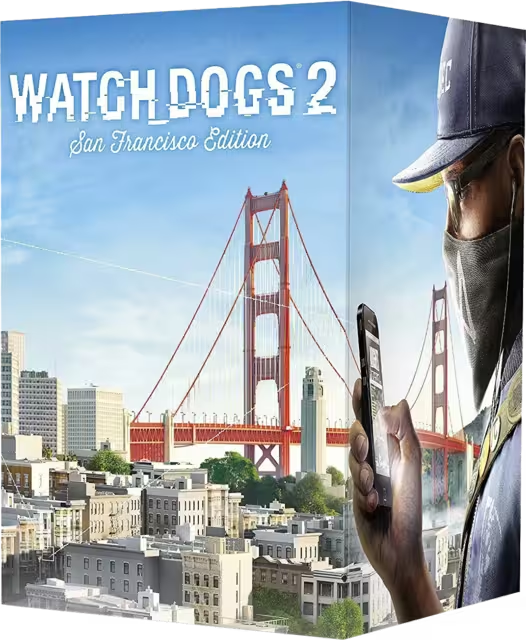
The Watch Dogs franchise has undergone a significant tonal and mechanical shift. The original release was defined by its serious, somber tone and Aiden’s stoic personality. The sequel, Watch Dogs 2, pivoted to a vibrant, lighthearted aesthetic in San Francisco, introducing more playful hacking gadgets like drones and RC jumpers while focusing on a group of youthful activists. Watch Dogs: Legion further experimented by removing a fixed protagonist entirely, allowing players to recruit and play as any NPC in a futuristic London. While later entries expanded the hacking as a playground concept, only this first title leaned fully into the darkness of the surveillance state and the voyeuristic tension of a lone vigilante. In retrospect, many critics came to appreciate the tonal depth this had over its successors. Although flawed, it sold over 10 million copies and established a foundation for the series.
| Item Name |
|
|---|---|
| Item Code |
|
| Item Number |
|
| Series | |
| Type | |
| Genre | |
| Characteristics | |
| Territory | |
| Packaging | |
| Documentation | |
| Developer | |
| Publisher | |
| Media | |
| Players | |
| Peripherals | |
| Video Modes | |
| Classification | |
| Release Date | |
| Date Added |
|