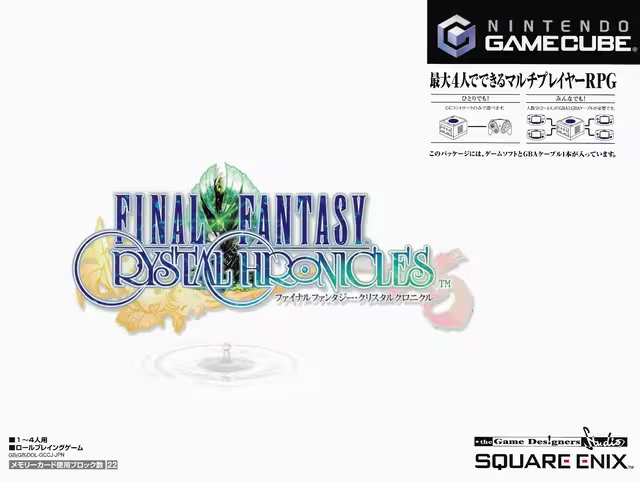
Final Fantasy Crystal Chronicles
DOL-GCCJ-JPN
Video Game Collection


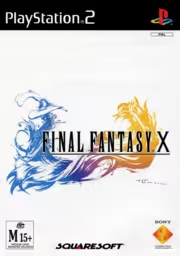 Front Cover
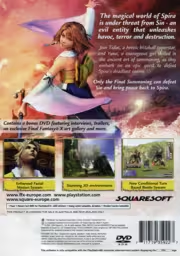 Back Cover
A cinematic landmark in the RPG genre, remembered for its innovative Conditional Turn-Based combat system and for being the first entry to bring professional voice acting and fully 3D environments to the Final Fantasy series.
Final Fantasy X saw a significant departure from the pre-rendered backgrounds and silent protagonists of its predecessors, instead delivering the series’ first fully 3D world with integrated voice acting. The title is an attempt to reinvent the franchise with an Asian-inspired aesthetic and a more personal, character-driven narrative. It remains a unique entry that moved the series away from the traditional “world map” exploration of the fifth generation toward a more seamless, linear, and cinematic progression, reflecting the industry’s push toward high-fidelity visuals and narrative maturity during the PlayStation 2’s generation.
The gameplay revolves around the pilgrimage of the summoner Yuna and her guardian Tidus across the world of Spira to defeat the cyclical threat known as Sin. This entry introduced the Conditional Turn-Based (CTB) battle system, which removed the real-time pressure of previous games in favour of a strategic timeline where character speed and specific actions directly influence the turn order. One notable feature is the Sphere Grid, a non-linear character progression system that replaced traditional experience levels with a board-game-like map of stat nodes and abilities. The game also shifted the role of summoned monsters (Aeons), making them fully controllable party members with their own unique move sets rather than simple one-off cinematic attacks.
On a technical level, the development was defined by several high-stakes pivots as Square adapted to the PlayStation 2’s capabilities. Only six months before the final deadline, the team decided to overhaul the game’s visual priority, switching toward a higher resolution output to meet evolving “next-gen” expectations. This transition required massive, late-stage modifications to nearly every asset. Additionally, the inclusion of voice acting created significant localisation hurdles; the English dialogue had to be timed perfectly to the Japanese lip-syncing because even a half-second discrepancy in line length could cause the engine to crash. The decision to remove the traditional world map was a direct response to the ballooning costs of rendering an entire globe in 3D, a choice that allowed developers to redirect those resources into the unprecedented facial detail and emotional animations that defined the game’s cutscenes.
Upon release, Final Fantasy X received overwhelming critical acclaim and was hailed as a technical masterpiece for the platform. Magazine reviewers praised the “breath-taking” visuals and the strategic depth of the CTB system, though some fans initially debated the loss of the world map and the game’s more linear structure. Reception was exceptionally strong globally, with the game becoming a multi-million seller and spawning the series’ first direct sequel, Final Fantasy X-2. Retrospectively, it is viewed as a high-water mark for the RPG genre, remembered for its emotional storytelling and for successfully navigating the franchise’s transition into the fully-voiced, 3D era.
| Item Name |
|
|---|---|
| Original Name |
|
| Item Code |
|
| Item Number |
|
| Series | |
| Type | |
| Genre | |
| Region | |
| Territory | |
| Packaging | |
| Documentation | |
| Developer | |
| Publisher | |
| Distributor | |
| Media | |
| Players | |
| Classification | |
| Release Date | |
| Date Added |
|