Digital Monster Ver. 5

デジタルモンスター Ver.5

A single‑game electronic device that is the fifth instalment in the original series of Digimon virtual pets.

Description

Digital Monster Ver. 5, originally released in Japan in August 1999, features a roster of 14 trainable Digimon and focuses on “dark” and “monstrous” creatures often found in urban or machinery-themed environments. This version centers on Zurumon and Pagumon as its base forms, introducing iconic “virus” types like the sharp-clawed Gazimon and the aquatic Gizamon. The device follows the established five-stage evolution cycle, beginning with a hatching egg and progressing through Baby I, Baby II, Child (Rookie), Adult (Champion), and finally the Perfect (Ultimate) stage.

Version 5 is unique for introducing the “Shadow Boxing” training mechanic, where players must strategically time button presses to overcome a digital opponent, a system that requires more precision than the simple mashing of earlier versions. To achieve the highest evolutionary forms, such as MetalTyranomon, the cybernetic Nanomon, or the rare Ex-Tyranomon, the pet demands high-intensity care: typically requiring 15 or more battles at both the Child and Adult stages with a victory ratio of 80% or higher. Like all original “bricks,” it features the “Battle Connect” metal contacts, allowing it to link and fight against other virtual pets in the series.

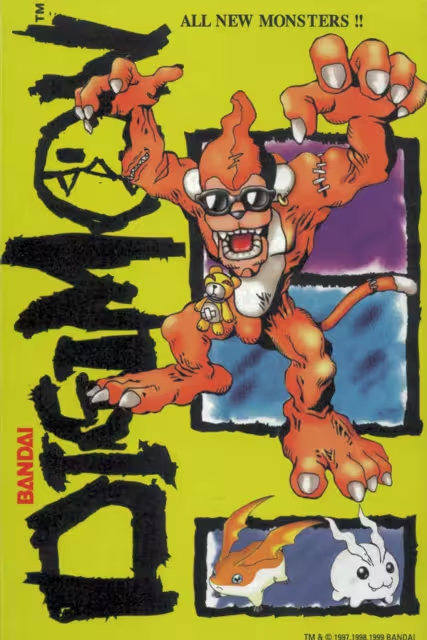
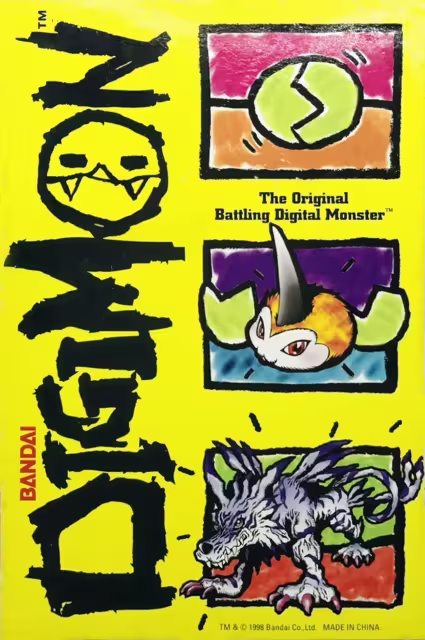
This specific Digital Monster Ver. 5 is the official “Asian-English” export released for the Australian and East Asian markets. While it shares software with the Japanese original, your unit carries the unique #05515 product ID, a specialised SKU used for late-wave assortments in the Oceania region. The “489” Hong Kong prefix reflects Bandai’s updated logistics for the Australian market.

Datasheet

Item Name
  • Digital Monster Ver. 5
Original Name
  • デジタルモンスター Ver.5
Item Code
  • 05515
Item Number
  • 4543112055156
Series
Class
Characteristics
Territory
Packaging
Documentation
Manufacturer
Distributor
Players
Release Date
Date Added
  • 1 January 2002