Utopia: The Creation of a Nation
SNS-UP-USA
Video Game Collection


 Box Front
 Box Back
An expansive management simulation that broadens the scope of equine legacy through increased statistical granularity and structural depth. It moves beyond the foundational boundaries of its predecessor to establish a more intricate web of professional relationships and genetic potential.
Winning Post 2 centres on the multi-generational journey of a racing stable aiming for dominance across the prestigious Japanese Grade I circuit. The narrative is driven by the player’s interactions with a growing cast of trainers, jockeys, and rival owners who develop individual reputations over decades of simulated time. The atmosphere is one of professional prestige, emphasising the patience required to cultivate a world-class bloodline from humble beginnings. It captures the social weight of the industry, where the player must balance financial stability with the pursuit of a legendary racing pedigree.
Gameplay remains predominantly menu-driven, utilising an interface that tracks thousands of data points across a persistent world. Mechanics emphasise the super horse system and refined breeding algorithms, where the player must account for specific stallion compatibility and lineage traits to produce competitive offspring. It utilises a battery backup to maintain a massive database of race histories and pedigree charts that evolve over a hundred years of simulation. The hardware is pushed to manage complex table lookups and RNG calculations that simulate horse fatigue, morale, and track conditions. It supports a single player and features digitised portraits for key personnel to add a layer of visual personality to the data-heavy experience.
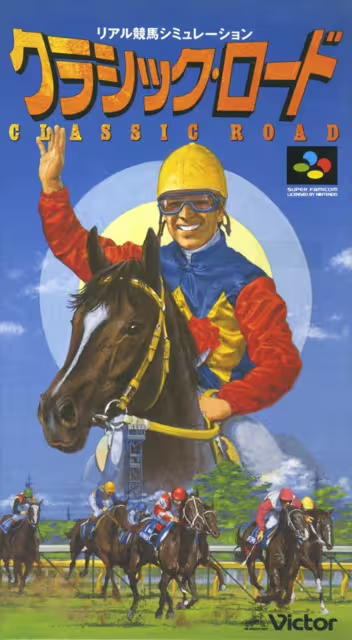
While the first Winning Post established the basic loop of buying and breeding, this sequel introduces the ability to influence the wider racing world through expanded social networking and character-driven events. Later titles such as Winning Post 3 and Winning Post 4 further expanded these systems by introducing more complex international racing calendars and advanced 3D race visualisations. The series eventually faced stiff competition from Derby Stallion 96, which prioritised a faster, more arcade-friendly loop, and Classic Road, which offered a different take on the breeding formula. This entry stands as the point where the series fully committed to its identity as a professional-grade simulation of the entire racing ecosystem.
Contemporary critics praised the game for its massive increase in content and the refined user interface that made navigating dense menus more intuitive. The AI felt more competitive and that the deeper pedigree systems offered far more replay value than the original release, yet it was also criticised for being even more demanding than its predecessor, requiring a significant time investment that could alienate casual players. Retrospectively it was the peak of 16-bit management simulations and a notable iteration in the series’ long-standing dominance of the market through a deep, data-driven experience.
| Item Name |
|
|---|---|
| Original Name |
|
| Item Code |
|
| Item Number |
|
| Series | |
| Type | |
| Genre | |
| Region | |
| Territory | |
| Packaging | |
| Documentation | |
| Developer | |
| Publisher | |
| Media | |
| Players | |
| Peripherals | |
| Launch Price |
|
| Release Date | |
| Date Added |
|