Feel The Magic: XY/XX
NTR-APRE-USA
Video Game Collection


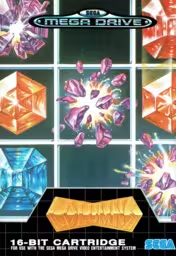 Front Cover
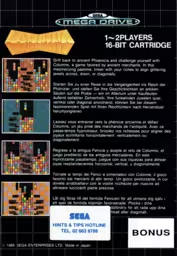 Back Cover
The foundational Sega puzzle experience, remembered for its elegant Match-3 mechanics and its soundtrack that provided a sophisticated alternative to the era’s more frantic shooters.
Columns was Sega’s high-stakes answer to Nintendo’s Tetris. Originally developed for arcades, this Mega Drive port served as the definitive home version for years. It is a critical piece of Sega’s history, documenting the company’s efforts to find a ‘killer app’ for the puzzle genre that could compete with the Game Boy’s handheld dominance.
The gameplay experience centres on a “Match-3” vertical alignment system rather than shape-fitting. Players control falling “columns” of three coloured gems, with the ability to cycle the order of the gems as they fall. A significant functional suite is the inclusion of the “Flash Columns” mode, where the goal is to clear a specific flashing jewel buried at the bottom of a pre-filled well. This added a layer of strategic planning that was absent from the standard “Endless” mode. The game also featured a robust two-player versus mode, which became a favourite in the competitive puzzle scene of the early 90s.
On a technical level, Columns is noted for its early utilisation of the Mega Drive’s colour palette to create a high-contrast, jewel-toned aesthetic. Because the game’s logic was relatively simple, the developers were able to dedicate the cartridge’s small 1 Megabit capacity to high-quality art for the various backgrounds, ranging from Greek temples to geometric patterns, ensuring that the game felt “premium” despite its minimalist mechanics. It is anchored by its ‘Clotho’ theme, a piece of FM-synth classical-inspired music that remains one of the most iconic tracks in the 16-bit era. The game utilised the Yamaha YM2612 sound chip to produce a clean, bell-like quality to its sound effects that matched the crystalline theme.
Upon release, Columns was a critical success, though it was often unfairly compared to Tetris. Reviewers praised its “zen-like” atmosphere and superior presentation, noting that it offered a more visually lush and musically sophisticated experience than its Russian rival. Public sentiment was strong; while it never reached the global cultural saturation of Tetris, it became a staple of both the Sega library, especially in Australia and Europe where it was frequently bundled with the Mega Drive console. Critics did point out that the game’s difficulty curve was relatively flat compared to the frantic speed of later puzzle games, making it more of a “relaxation” title than a high-stress competitive one.
| Item Name |
|
|---|---|
| Item Code |
|
| Item Number |
|
| Type | |
| Genre | |
| Characteristics | |
| Region | |
| Territory | |
| Packaging | |
| Documentation | |
| Developer | |
| Publisher | |
| Distributor | |
| Media | |
| Players | |
| Release Date | |
| Date Added |
|