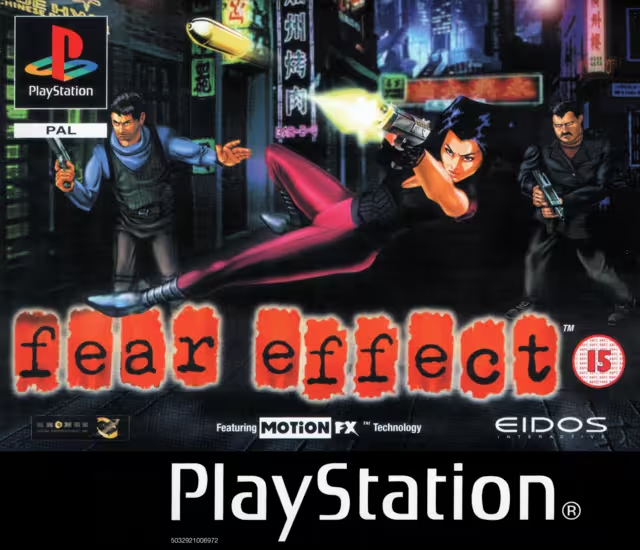
Fear Effect
SLES-02166~32166-
Video Game Collection


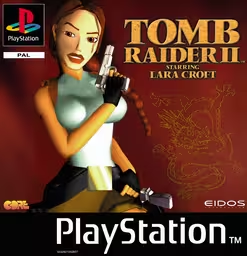 Front Cover
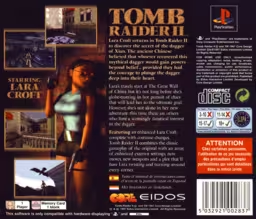 Back Cover
A cinematic evolution of the action-adventure genre remembered for its expanded globetrotting scale, the introduction of vehicular segments, and for solidifying Lara Croft as a global cultural icon during the early PlayStation era.
Tomb Raider II saw the franchise move away from the isolated, tomb-centric atmosphere of the original in favour of more urban and modern settings, such as the canals of Venice and a sunken ocean liner. The title arrived as one of the most anticipated sequels of the early 32-bit generation. It reflects a design direction that prioritised increased combat intensity and environmental variety, introducing human enemies with firearms to supplement the previous game’s focus on wildlife and platforming. This entry successfully navigated the sophomore slump, delivering a more polished and expansive experience that defined the Lara Croft peak of the late 90s.
The gameplay experience is built around complex grid-based platforming and environmental puzzle-solving across locations including the Great Wall of China, Tibet, and an offshore drilling rig. This iteration introduced several key mechanical additions, most notably the ability to climb ladders and trellis-work, as well as the implementation of a flare system for navigating the game’s many pitch-black corridors. A standout feature was the introduction of vehicles, allowing Lara to pilot speedboats through Venice and snowmobiles across the Tibetan foothills. The game is famously remembered for the Croft Manor training level, which was expanded to include an outdoor assault course and the ability to lock Lara’s long-suffering butler, Winston, inside the walk-in freezer.
The development was had a rapid one-year turnaround, with the team utilising an upgraded version of the original engine to meet an aggressive Christmas release deadline. A major technical achievement was the implementation of dynamic lighting (such as the glow from flares) and Lara’s new flowing ponytail, which was a significant graphical feat on the PS1’s limited polygon budget. However, when played on the PlayStation 2 and more modern backward compatibility players often notice issues, such as shimmering textures and frequent Z-fighting (flickering polygons) where environmental surfaces overlap. Unlike many of its peers, Tomb Raider II utilises Redbook Audio (CDDA) for its soundtrack, meaning the music is streamed directly from the disc, which limited the developers’ ability to implement dynamic, reactive scoring during gameplay.
Upon release, Tomb Raider II received overwhelming critical acclaim, with many praising the increased length and the improved outdoor environments. Magazine reviewers lauded the improved controls and the sheer scale of levels, though some noted that the focus on human combat made the game significantly more difficult than the first. Reception was particularly strong in the PAL region, where it became a definitive must-have title for the console. Retrospectively, it is was a foundational masterpiece of 3D level design, remembered for its atmospheric soundtrack by Nathan McCree and for setting the high-water mark for the original five-game PlayStation run.
| Item Name |
|
|---|---|
| Item Code |
|
| Item Number |
|
| Series | |
| Type | |
| Genre | |
| Region | |
| Territory | |
| Packaging | |
| Documentation | |
| Developer | |
| Publisher | |
| Distributor | |
| Media | |
| Players | |
| Peripherals | |
| Classification | |
| Launch Price |
|
| Release Date | |
| Date Added |
|