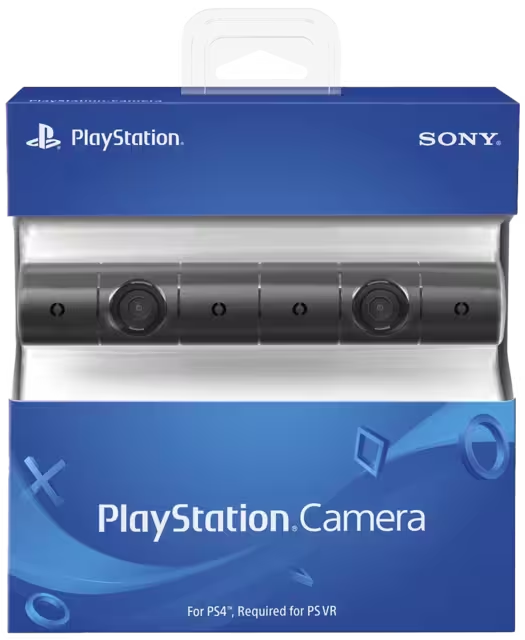
PlayStation Camera
CUH-ZEY2
Video Game Collection


 Top
Top
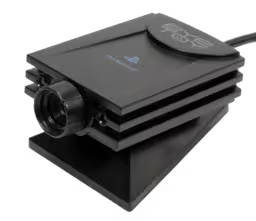 EyeToy
A pioneering motion-control peripheral that transformed the player’s physical image into the primary input device for the PlayStation 2. It represents a significant milestone in computer vision technology, bridging the gap between traditional controller-based play and gesture-driven interaction through a simple but effective camera-interface.
The EyeToy brings a social, high-energy atmosphere to the living room, effectively turning the player into the controller. The experience sees one’s own silhouette superimposed on the television screen, interacting with digital objects in a way that felt like magic in 2003. It introduced accessible, physical movement: waving, swatting, and dancing; making it a focal point for party gaming and family gatherings. Although its has slightly complex history, it emerged through the blue sky philosophy of Sony’s London Studio and SCE Europe. The peripheral supported a range of motion-driven games, utilising a fixed-lens camera that tracks changes in pixel luminance to detect movement. Later titles, including a small number of PS3 games utilised it purely for its video input. Overall it was a creative pillar along with the SingStar and Buzz! franchises, which collectively defining the PS2 era’s social gaming.
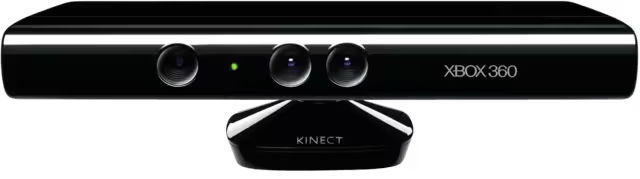
The hardware was produced in several distinct iterations across the PlayStation 2’s lifespan. The original SLEH-00030 and this SLEH-00031 models, manufactured by Logitech and Namtai respectively, both match the original PS2 design with black rectangular housing. A later SCEH-0004 model, also manufactured by Namtai, came in significantly smaller silver casing designed to match the Slimline PS2. All units feature a VGA sensor that operates at QVGA (320×240) resolution, and include an integrated microphone. While it lacks depth sensors of later generations, the software compensates through clever use of active zones on the screen that trigger specific actions when disturbed by the player’s movement. This peripheral is the direct ancestor to the PlayStation Eye on PS3 and the PlayStation Camera on PS4/PS5, as well as a key influence on the development of Microsoft’s Kinect. Its reliance on 2D motion tracking draws parallels to early arcade experiments and the Sega Dreamcast’s Dreameye, which was the first console camera peripheral.
The reception at launch was a mix of genuine wonder and mild frustration. It did genuinely present a revolution in interface design, encouraging traditional gamers and non-gamers alike to be active and engaged with the console. However, the reality of the technologies limits was always there. At this price point in that era any sensor would be extremely sensitive to poor lighting, resulting in tracking failing or becoming erratic. Also the lack of traditional tactile feedback also meant that gameplay was imprecise and could become fatiguing. It was the packaging of cutting edge techs brought to the mainstream, gambling on a novelty that paid off. Ultimately it would pave the way for the motion-control boom of the mid-2000s, before the novelty finally faded and we ended back exactly where we started.
| Item Name |
|
|---|---|
| Item Code |
|
| Type | |
| Class | |
| Color | |
| Packaging | |
| Documentation | |
| Developer | |
| Manufacturer | |
| Publisher | |
| Distributor | |
| Video Modes | |
| Release Date | |
| Date Added |
|