Scooby-Doo! Mystery Mayhem
SLES-51883
Video Game Collection


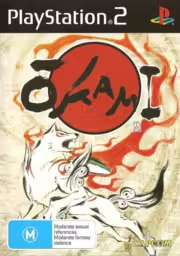 Front Cover
 Back Cover
A vibrant masterpiece of interactive art, that features a unique “Celestial Brush” mechanic and a striking sumi-e aesthetic to deliver one of the most culturally rich and visually innovative adventures on the PlayStation 2.
Ōkami is a visually stunning action-adventure that stands as one of the most creatively daring titles of the PlayStation 2 era. It eschews traditional 3D realism in favour of a “sumi-e” ink-wash aesthetic, effectively turning the screen into a living Japanese parchment. You play as Amaterasu, the sun goddess in the form of a white wolf, on a quest to restore color and life to a world sapped of its vitality by the eight-headed demon Orochi. The story features a distinct cultural soul rooted deeply in Japanese folklore and Shinto mythology.
The defining mechanic is the Celestial Brush, which allows you to pause the action and draw symbols directly onto the screen to interact with the world. Drawing a circle in the sky creates the sun; a quick horizontal line becomes a “Power Slash” to cut through boulders or enemies. This system seamlessly integrates combat, puzzle-solving, and environmental restoration, making you feel less like a warrior and more like a creative force of nature. The game’s world is dense with detail, from the blossoming cherry trees you restore to the eccentric cast of gods and spirits you encounter, all rendered with a unique heavy-outline technique that pushes the PS2’s hardware to its aesthetic limits.
Visually, Ōkami is famous for its “Paper Filter”, a texture overlay that gives the game its grainy, hand-made feel. On the original PS2 hardware, this filter is notably more pronounced than in later HD and 4K remasters, contributing to a softer, more atmospheric glow that many purists prefer. The game also utilises a sophisticated “blooming” effect to represent divine power, which, combined with the watercolor-inspired color palette, creates a sense of scale and beauty that was unprecedented on the console. Despite the complexity of its visuals, the game maintains a remarkably stable performance, though the sheer density of some late-game environments can occasionally tax the hardware.
When launched, Ōkami was a critical darling, winning numerous “Game of the Year” awards for its art direction and innovative gameplay, though it famously struggled with initial commercial success, making it a quintessential “cult classic.” Reviewers praised it for its length, its heart, and the way it made environmentalism feel like a heroic act. Today, it remains a landmark archival title, representing the peak of Clover Studio’s creativity before they transitioned into PlatinumGames. A masterpiece of art-as-gameplay, proving that the PS2 was capable of delivering experiences that were not just technically impressive, but genuinely transcendent.
| Item Name |
|
|---|---|
| Original Name |
|
| Item Code |
|
| Item Number |
|
| Type | |
| Genre | |
| Region | |
| Territory | |
| Packaging | |
| Documentation | |
| Developer | |
| Publisher | |
| Media | |
| Players | |
| Sound Modes | |
| Classification | |
| Release Date | |
| Date Added |
|