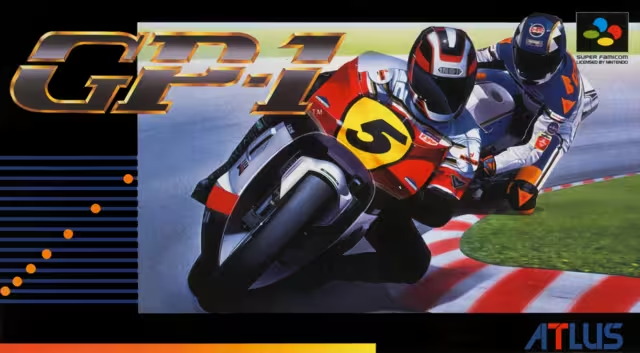
GP-1
SHVC-G7
Video Game Collection


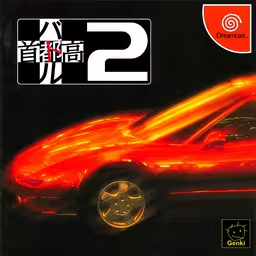 Front Cover
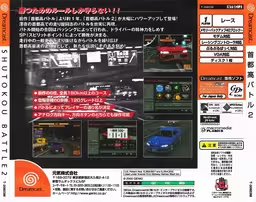 Back Cover
Genki’s street‑racing game, expanding the original’s highway racing formula with a larger map, more cars, and hundreds of rival drivers to challenge across Tokyo’s expressways. Known internationally as Tokyo Highway Challenge 2 (or Tokyo Xtreme Racer 2 for Americans).
Shutokou Battle 2 was the direct sequel to Genki’s Shutokou Battle, continuing the series’ distinctive focus on illegal highway racing set on Tokyo’s Shuto Expressway system, but broadened the scope considerably. In addition to the central C1 Loop, players could now race on the Shinkanjo, Wangan Line, and Yokohane Line, creating a more expansive and interconnected road network. As a fan of Genki’s racing series and particularly the initial Dreamcast title, this was a large step up taking a relatively narrow concept with an amazing gameplay loop, into a fully fleshed out experience.
The core gameplay retained the SP (Spirit Points) battle system, where each car has a vitality bar that depletes when the driver takes damage from collisions or falls behind. Races are not traditional laps but head‑to‑head duels, with victory achieved by draining the opponent’s SP. This system gave the game a unique rhythm compared to conventional circuit racers. The car selection was broader than the first game, featuring licensed Japanese imports and tuners, with extensive customisation options for performance and appearance. The game also added more narrative framing: the player assumes the role of Motoya Iwasaki, a racer on his path to becoming the legendary “Speed King.” Shutokou Battle 2 introduced a massive roster of 372 rivals, organised into teams, bosses, and a new category called Wanderers, lone drivers with special conditions for appearing, such as driving a certain car, racing on a specific day, or having logged enough mileage. This added a layer of strategy and collection‑style progression, as players sought to unlock and defeat every rival.
Visually, the Dreamcast hardware provided a solid performance with a smooth experience, detailed car models, and atmospheric night‑time cityscapes. The soundtrack leaned into electronic and rock influences, complementing the high‑speed duels on neon‑lit highways. It’s was one of the Dreamcast’s standout racing titles, among an already diverse lineup of great titles.
The expanded map, rival variety, and addictive progression loop made for quite a popular game. The game became a cult favourite, particularly in Japan and solidified Genki’s reputation and the Shutokou Battle series, which continued on the PlayStation 2. The game captured the underground street‑racing culture of Tokyo when it was still authentic, years before it became mainstream in films and other media.
| Item Name |
|
|---|---|
| Original Name |
|
| Item Code |
|
| Item Number |
|
| Series | |
| Type | |
| Genre | |
| Region | |
| Territory | |
| Packaging | |
| Documentation | |
| Developer | |
| Publisher | |
| Media | |
| Players | |
| Peripherals | |
| Video Modes | |
| Classification | |
| Launch Price |
|
| Release Date | |
| Date Added |
|