Castle of Illusion Starring Mickey Mouse
ミッキーマウスのキャッスルイリュージョン

-
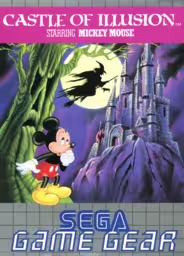 Box Front
-
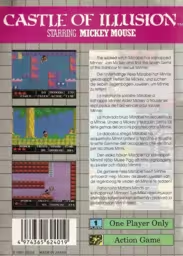 Box Back
A vibrant and remarkably inventive 8-bit platformer remembered for stepping out of its 16-bit sibling's shadow to deliver a completely distinct, puzzle-infused adventure. Translates the Master System counterpart to a handheld, albeit with the infamous screen crunch that defined early portable gaming. A journey through enchanted worlds where Mickey confronts illusions and magical foes, blending whimsical design with themes of courage, imagination, and the triumph of wonder over fear.
Description
Castle of Illusion Starring Mickey Mouse saw Sega aggressively push their new handheld by offering a near-identical port of the critically acclaimed Master System release in 1991. Like its console sibling, it is an entirely original game built independently of the 16-bit Mega Drive version. It captures a specific era where Sega positioned the Game Gear as a technologically superior, full-colour alternative to the Game Boy, striving to deliver uncompromised home console experiences on the go. It reflects a design direction that prioritised deliberate pacing and light puzzle-solving over purely reflex-driven action, establishing a high watermark for licensed handheld titles.
The gameplay experience is built around navigating a series of themed doors within Mizrabel’s castle to rescue Minnie Mouse. The core progression relies on a fundamental object-carrying mechanic, requiring players to pick up and throw blocks, chests, barrels, and rocks to defeat enemies or stack them to reach higher platforms. The level themes diverge significantly from the 16-bit counterpart; while the Woods and Toyland are present, this 8-bit iteration features entirely unique environments, most notably a sprawling Dessert/Sweets level. The game also features a non-linear approach to some stages, requiring players to search for keys to unlock doors rather than simply moving left to right.
The game’s development was defined by the double-edged sword of the Game Gear’s hardware. Most positive was the visual presentation; because the Game Gear possessed a significantly larger master colour palette than the Master System (4096 colours versus 64), the developers were able to implement slightly richer shading, making the beautifully animated sprites pop on the backlit screen. However, the handheld screen resolution resulted in a massive structural negative. The drop from the Master System’s 256×192 display to the Game Gear’s 160×144 resulted in a severe camera crop rather than a scaling of the graphics. This zoom effect introduced incredibly frustrating blind jumps, forcing players to take literal leaps of faith into unseen enemies or pits, artificially inflating the difficulty.
Upon release, the Game Gear version of Castle of Illusion received universal acclaim and was widely considered a killer app for the young system. Magazine reviewers lauded it for proving that true console-quality graphics and gameplay could survive the transition to a portable format. Reception was incredibly strong across all regions, helping to solidify the Game Gear’s early market presence against Nintendo. Retrospectively, while it remains a foundational and beloved handheld platformer, modern players and archivists generally consider the Master System version the definitive way to experience the 8-bit code, purely to escape the claustrophobia of the cropped viewport.
Datasheet
| Item Name |
|
|---|---|
| Original Name |
|
| Item Code |
|
| Item Number |
|
| Series | |
| Type | |
| Genre | |
| Theme | |
| Territory | |
| Packaging | |
| Documentation | |
| Developer | |
| Publisher | |
| Distributor | |
| Media | |
| Players | |
| Release Date | |
| Date Added |
|
Related Products
-
 Alex Kidd: The Lost Stars7005
 -
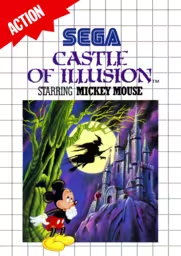 Castle of Illusion Starring Mickey Mouse7053
 -
 Disney•Pixar Finding NemoAGB-AZIP-UKV
 -
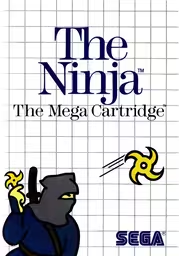 The NinjaMK-5066-50
 -
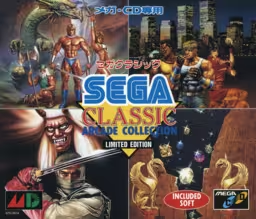 Sega Classic Arcade CollectionG-6012
 -
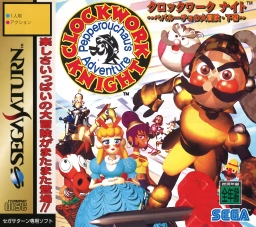 Clockwork Knight: Pepperouchau no Daibōken GekanGS-9029
 -
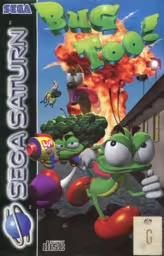 Bug Too!FBUG02SSC, MK81040-50
 -
 Shinobi: Fukushū no ZangekiHAC-BCU8A-JPN