Devil's Third
WUP-ADNP-AUS
Video Game Collection


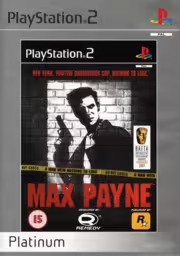 Front Cover
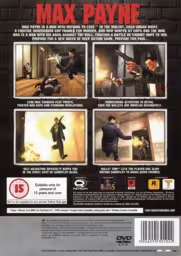 Back Cover
A cinematic noir masterpiece remembered for its iconic “Bullet Time” mechanic and its dark, graphic-novel-style storytelling that successfully brought PC-level grit to the early PS2 library.
Max Payne saw the arrival of Remedy Entertainment’s gritty, neo-noir thriller, marking one of the earliest and most successful transitions of a high-end PC title to the PlayStation 2. The game captures the dark, revenge-driven journey of a fugitive DEA agent in a snowbound New York City, moving away from the bright, arcade-style shooters of the fifth generation in favour of a cinematic, narrative-heavy experience. It reflects a design direction that prioritised atmosphere and physics-based combat, introducing the wider gaming public to the “Bullet Time” mechanic during the first year of the sixth generation.
The gameplay experience is built around third-person gun play and a revolutionary slow-motion combat system. This entry introduced the Bullet Time meter, which allows players to slow down the action to a crawl while maintaining full aiming control, enabling Max to dive through the air while picking off multiple enemies in mid-flight. Unlike many shooters of the era, the game emphasises tactical positioning and the use of the environment. Max is physically vulnerable and must rely on painkillers to restore health. The narrative is uniquely structured through a series of graphic novel panels with voice-over narration, a creative choice that allowed for deep storytelling without the technical strain of fully animated, high-fidelity cutscenes.
On a technical level, the development was defined by the massive challenge of porting the sophisticated MaxFX engine to the PlayStation 2’s hardware. A major technical positive was the particle and physics system, which managed to retain much of the PC version’s environmental interactivity, such as breaking glass, wall-shattering bullet impacts, and realistic shell casing ejection, all at a time when such details were rare on consoles. However, the PS2 version faced significant technical negatives; it was plagued by extremely long loading times between short segments and a noticeable decrease in texture resolution. Additionally, to fit the game into the console’s memory, the developers had to drastically reduce the geometry of certain levels, leading to a more boxed-in feel compared to the PC original. The lack of a quick-save feature, replaced by limited manual save points, also significantly increased the game’s difficulty curve.
Max Payne received a highly positive reception, lauded for its mature tone and the unprecedented appeal of its Bullet Time mechanics. Magazine reviewers praised the gritty atmosphere and the quality of James McCaffrey’s voice acting, though they frequently noted that the PS2 version’s visual compromises were the trade-off for such ambitious gameplay. Reception was strong globally, solidifying the title as a “must-have” for early PS2 adopters who wanted a mature alternative to the platform’s more colourful mascot games. Retrospectively, it was a foundational action title, remembered for its noir-drenched style and for proving that cinematic storytelling and complex combat could coexist seamlessly on a home console.
| Item Name |
|
|---|---|
| Item Code |
|
| Item Number |
|
| Series | |
| Type | |
| Genre | |
| Characteristics | |
| Region | |
| Territory | |
| Packaging | |
| Documentation | |
| Developer | |
| Publisher | |
| Distributor | |
| Media | |
| Players | |
| Classification | |
| Release Date | |
| Date Added |
|