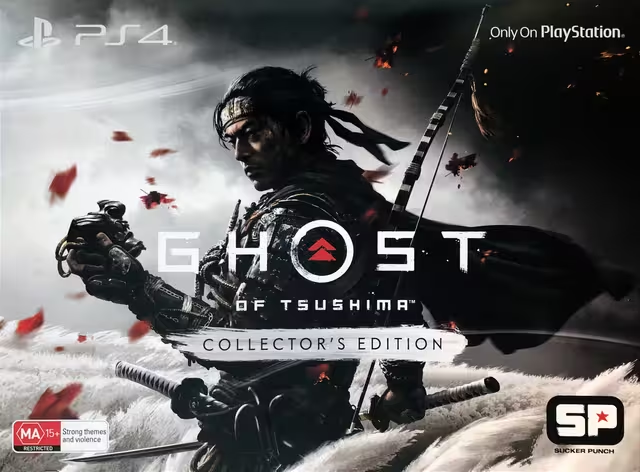
Ghost of Tsushima (Collector's Edition)
CUSA-13323(CE)
Video Game Collection

A harrowing continuation of a post‑pandemic survival story, it pushed the boundaries of interactive drama by confronting players with cycles of violence, grief, and moral ambiguity, becoming one of the most debated works in modern video games. The remastered edition on PlayStation 5 enhanced this experience with improved visuals, faster loading, and new modes that invited players to revisit its world with fresh perspectives.
The Last of Us Part II Remastered follows Ellie and Abby, two characters whose lives become intertwined after a brutal act of revenge sets off a chain of escalating consequences. Unlike many other action‑adventure titles, it deliberately slows the pace to dwell on the emotional cost of violence. Players are asked not only to fight through hostile environments filled with infected creatures and human factions, but also to inhabit the perspectives of both victim and perpetrator. This dual structure forces a confrontation with empathy: the same events are reframed depending on whose eyes you see them through, challenging the instinct to divide characters neatly into heroes and villains.
Thematically, the game is a meditation on revenge and its futility. Where the first installment centred on love and the lengths one might go to protect it, Part II explores what happens when love curdles into hatred. Its narrative insists that violence is not cathartic but corrosive, leaving scars on those who commit it as much as those who suffer it. The bleakness of this vision sparked intense debate: some praised its unflinching honesty, while others found it punishing or nihilistic. Yet this very divisiveness underscores its cultural relevance: it treated a blockbuster video game not as escapism but as a vehicle for difficult questions about morality, forgiveness, and the human cost of vengeance.
On PlayStation 5, this remastered edition reinforced these themes with technical refinements and additional content. Enhanced textures, lighting, and performance made its environments more immersive, while the “No Return” roguelike survival mode offered a new way to engage with its mechanics outside the linear narrative. Developer commentary and behind‑the‑scenes features further contextualised its creation, encouraging players to reflect not only on the story but on the artistry behind it.
In a broader cultural sense, The Last of Us Part II is significant because it demonstrates how games can function as serious narrative art. Its willingness to alienate or unsettle players places it closer to literature or cinema that challenges audiences rather than comforts them. Released during a period of global uncertainty, it resonated with themes of loss, isolation, and the search for meaning in a broken world. Whether embraced as a masterpiece or criticised for its choices, it remains a touchstone in discussions about what interactive storytelling can achieve, and how games can provoke reflection well beyond the screen.
| Item Name |
|
|---|---|
| Item Code |
|
| Item Number |
|
| Series | |
| Type | |
| Genre | |
| Characteristics | |
| Territory | |
| Packaging | |
| Documentation | |
| Developer | |
| Publisher | |
| Distributor | |
| Media | |
| Players | |
| Peripherals | |
| Video Modes | |
| Classification | |
| Launch Price |
|
| Release Date | |
| Date Added |
|