Yamato
ヤマト
-
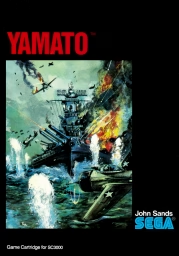 Box Front
-
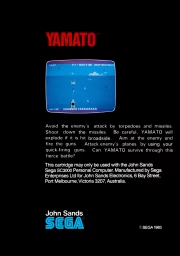 Box Back
An early naval shooting game in which the player commands the battleship Yamato, alternating between anti-aircraft fire and torpedo attacks while defending against approaching ships, aircraft, missiles, and torpedoes.
Description
Yamato is an shooting game ported from the arcade and introduced with the SG-1000. The game takes its name and central imagery from the Japanese battleship Yamato, placing a simplified representation of the vessel as enemy forces approach from the sea and sky. The battlefield is viewed from behind the Yamato, with the horizon dividing naval and aerial targets. The player moves a crosshair across the upper portion of the screen to fire the ship’s guns at aircraft, missiles, and distant vessels, while a separate control launches torpedoes towards ships travelling across the water. Incoming torpedoes have be intercepted before reaching the player’s vessel, requiring attention to threats at different distances while continuing to attack enemy formations. Each short round introduces another wave, with enemy numbers, movement, and projectile pressure increasing as the game progresses.
Its divided control scheme reflects the arcade original’s unusual cabinet, which used separate controls for the Yamato’s guns and torpedoes. Compressing those functions onto the SG-1000 controller makes the conversion less physically distinctive, but preserves the underlying contrast between aiming at aerial and distant targets and launching torpedoes along the water. The game’s fixed perspective and overlapping threats give it some resemblance to early gallery shooters, although its combination of naval defence and two attack systems distinguishes it from more conventional single-screen shooters of the period. The home port is visually and mechanically austere, using a largely static seascape, compact sprites, limited sound, and rapidly repeating rounds. Nevertheless, its arcade action and two-level threat management give it greater mechanical identity than its simple presentation initially suggests.
As one of the earliest cartridges available for Sega’s first home-console family, Yamato is significant as an example of how the company started to approach home conversions, often through contract developers, in this case credited to “ELS”. Retrospectively it was among the relatively uncommon early Japanese games to use the Pacific War and an actual military vessel as its subject. Despite being very simple in is presentation its simultaneous need to engage ships and aircraft provides a genuine challenge.
Datasheet
| Item Name |
|
|---|---|
| Original Name |
|
| Item Code |
|
| Type | |
| Genre | |
| Theme | |
| Characteristics | |
| Territory | |
| Packaging | |
| Documentation | |
| Developer |
|
| Publisher | |
| Distributor | |
| Media | |
| Players | |
| Release Date | |
| Date Added |
|