Gears of War: Judgment


-
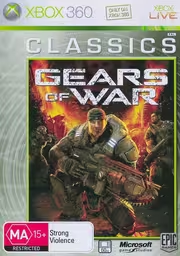
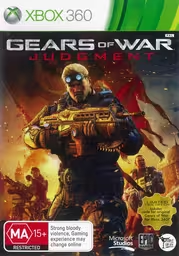 Front Cover
-
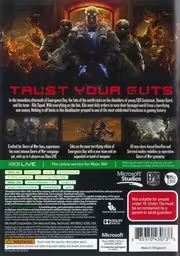 Back Cover
A cover shooter that acts as a prequel to the main trilogy that provided more arcade-style shorter missions with modifiers for replayability.
Description
Gears of War: Judgment (2013) shifts the series’ perspective away from Marcus Fenix and the Delta Squad, instead focusing on Damon Baird and Augustus “Cole Train” Cole during the early days of the Locust invasion. The game is framed as a military tribunal. Baird and his squad recount their actions in flashback missions, each testimony shaping the player’s experience. This courtroom structure introduces a sense of accountability and moral ambiguity, contrasting with the straightforward heroics of the earlier entries. The narrative explores themes of responsibility, sacrifice, and the blurred line between necessity and recklessness in wartime.
Gameplay introduces several notable changes. Missions are shorter, more modular, and often framed by “Declassified” modifiers: optional challenges that alter conditions (such as limited visibility, restricted weapons, or tougher enemies) in exchange for higher rewards. This system adds replayability and variety, but also shifts the pacing toward bite‑sized encounters rather than sprawling campaigns. The game also emphasises faster combat, more enemies on screen, and a scoring system that encourages mastery and competition. Compared to Gears of War 3, which leaned into cinematic storytelling and cooperative set‑pieces, Judgment feels more arcade‑like, prioritising quick challenges and replay value.
Its contribution to the series is complex. On one hand, it experiments with structure and mechanics, offering a fresh take on the formula. Some felt it diluted the series’ identity, with less emphasis on narrative depth and more on score‑driven gameplay. Although well polished and providing some variety, its story’s lacked the emotional weight and rhythm of prior entries. In retrospect, Gears of War: Judgment was the most experimental entry in the franchise with its spin on the narrative‑driven campaign formula before Gears of War 4 returned to a more traditional structure.
Datasheet
| Item Name |
|
|---|---|
| Item Code |
|
| Item Number |
|
| Series | |
| Type | |
| Genre | |
| Theme | |
| Characteristics | |
| Region | |
| Territory | |
| Packaging | |
| Documentation | |
| Developer | |
| Publisher | |
| Media | |
| Players | |
| Video Modes | |
| Middleware | |
| Classification | |
| Release Date | |
| Date Added |
|