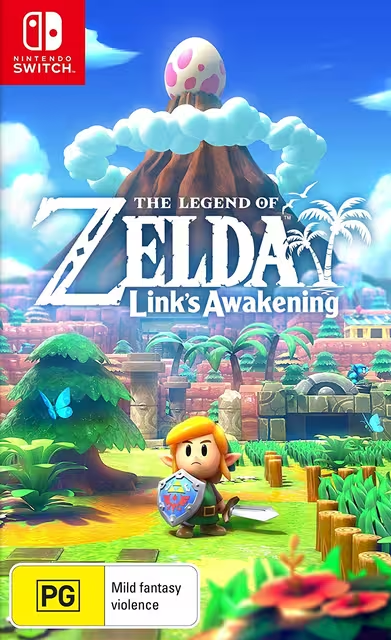
The Legend of Zelda: Links Awakening
HAC-AR3NA-AUS
Video Game Collection


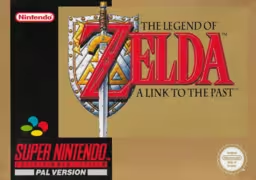 Box Front
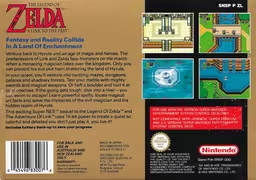 Box Back
An action‑adventure game for the Super Nintendo Entertainment System. It returned the series to a top‑down perspective, introduced the concept of parallel worlds, and established many of the mechanics that became staples of the Zelda franchise
Notably this is a later release as the packaging indicates Nintendo Australia distribution (1994 onwards).
The Legend of Zelda: A Link to the Past sees Link seek to rescue Princess Zelda, defeat the evil wizard Agahnim, and ultimately confront the demon king Ganon. This is where the Zelda series crystallised into the form that would define it for decades. Thematically, the game is built around duality and transformation. The game’s defining innovation was its dual‑world mechanic: the Light World and the Dark World, parallel versions of Hyrule with distinct aesthetics and challenges. This structure expanded exploration and puzzle‑solving, requiring players to shift between worlds to progress. The introduction of the Master Sword also became a cornerstone of the series’ mythology.
The Light World and Dark World mechanic is not just a clever puzzle device but a metaphor for corruption, consequence, and the hidden layers of reality. Hyrule is presented as a familiar medieval fantasy kingdom, but the Dark World reveals its distorted reflection: a place where greed, ambition, and Ganon’s influence twist the land and its inhabitants. This duality forces the player to confront the idea that heroism is not simply about defeating enemies but about navigating moral and spatial complexity.
Gameplay refined the overhead adventure model of the original Legend of Zelda but expanded it dramatically. The introduction of diagonal movement, multi‑level dungeons, and a broader arsenal of items gave players more freedom and tactical choice. The Master Sword became a mythic centrepiece, not just a weapon but a symbol of destiny and virtue. The dungeon design balanced combat, exploration, and puzzle‑solving in a way that felt more deliberate and layered than its predecessors. Compared to contemporaries like Secret of Mana or Final Fantasy IV, A Link to the Past avoided levelling systems and turn‑based combat. It focused more upon awareness of your environment, timing, and the creative use of tools.
Its contribution to the series cannot be overstated. The “Zelda formula” of a hub world leading to themed dungeons, each offering a new item that unlocks further exploration, culminating in a climactic boss battle, was codified here. Later entries, from Ocarina of Time to Twilight Princess, built directly on this structure. The dual‑world mechanic also became a recurring motif, echoed in Ocarina’s time travel, Twilight Princess’s twilight realm, and A Link Between Worlds.
Reception at the time was overwhelmingly positive with praise for its scale, atmosphere, and balance of challenge, while players were struck by the sense of freedom and discovery. Retrospectively, it is often cited as one of the greatest games of all time, not only for its technical achievements but for its emotional resonance. The haunting music of the Dark World, the triumph of drawing the Master Sword from its pedestal, and the gradual unveiling of Ganon’s plot remain iconic moments in gaming history. Link to the Past bridged the simplicity of 8‑bit adventure games and the narrative depth of later RPGs we continue to enjoy today. It demonstrated how games could be both accessible and profound and its influence is visible not only in Zelda’s own lineage but in countless action‑adventure titles that adopted its emphasis on exploration, puzzle‑driven progression, and thematic duality.
| Item Name |
|
|---|---|
| Original Name |
|
| Item Code |
|
| Item Number |
|
| Series | |
| Type | |
| Genre | |
| Region | |
| Territory | |
| Packaging | |
| Documentation | |
| Developer | |
| Publisher | |
| Distributor | |
| Media | |
| Players | |
| Release Date | |
| Date Added |
|