Virtua Racing Deluxe
GM-5001
Video Game Collection


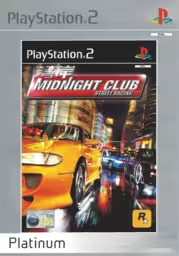 Front Cover
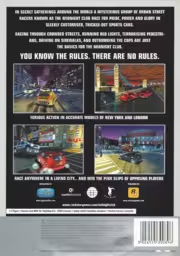 Back Cover
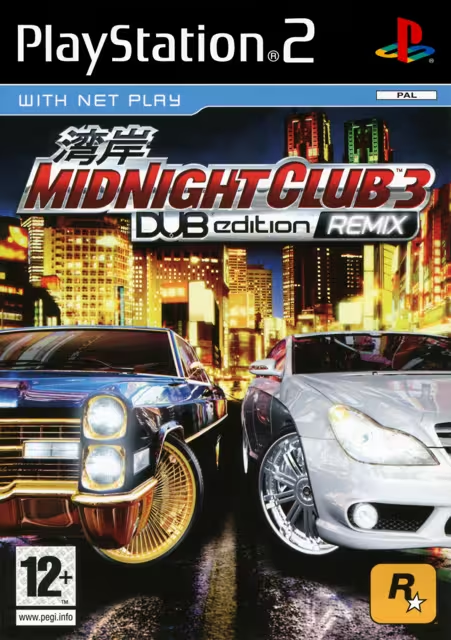
A gritty and open-ended launch title remembered for its no-rules checkpoint racing and for pioneering the open-city sandbox formula on the PlayStation 2. The Platinum version sold in Australia appears to be a straight European version with no localisation.
Midnight Club: Street Racing (2000) arrived as a launch title for the PlayStation 2, marking Rockstar Games’ ambitious entry into the burgeoning street-racing genre. The title captures the clandestine world of illegal night racing across London and New York City, moving away from the closed-circuit racers of the fifth generation in favour of open-city environments that allow for complete freedom of navigation. It reflects a design direction that prioritised arcade speed and sandbox exploration, laying the foundation for the open-world racing trends that would dominate the sixth generation.
The gameplay experience is built around finding and challenging rival Midnight Club members to high-stakes races across dense urban landscapes. This iteration introduced a checkpoint system that does not dictate a specific path, instead forcing players to learn the city’s shortcuts, alleys, and jumps to find the fastest route between markers. A standout feature is the “Career” progression, where defeating specific rivals unlocks their vehicles, which range from humble hatchbacks to high-performance supercars and modified taxis. The game also features a variety of modes, including “Waypoints,” “Capture the Flag,” and a free-roam mode that allows for aimless exploration of the two metropolitan areas.
The development was led by Angel Studios (later Rockstar San Diego), utilising their proprietary engine that was capable of rendering vast cityscapes with no mid-level loading. A major technical positive was the draw distance; for a year-2000 console title, the ability to see neon-lit skyscrapers and distant traffic while travelling at high speeds was a significant showcase for the PlayStation 2’s hardware. A major development hurdle involved the pedestrian and traffic AI, which had to be carefully balanced to ensure the cities felt “alive” without causing technical bottlenecks or making the races unfairly obstructed by erratic civilian drivers. However, the PS2 version faced notable issues, such as a frame rate that could become erratic during heavy rain or high-density traffic. The lack of licensed vehicles also left generic designs that felt somewhat anonymous compared to competitors.
Upon release, Midnight Club: Street Racing received a generally positive reception, often highlighted as one of the stronger launch titles for the platform. Magazine reviewers praised the unprecedented freedom of the open-city design and the sense of speed, though many noted that the high difficulty and lack of car customisation (a feature that would define the sequels) were significant drawbacks. Reception was strong among players who appreciated the gritty, urban atmosphere that contrasted with the more polished, professional feel of Gran Turismo. Retrospectively, it was a foundational title that proved open-world racing was viable on home consoles, remembered for its challenging navigation and its role in establishing Rockstar as a major force in the racing genre.
| Item Name |
|
|---|---|
| Item Code |
|
| Item Number |
|
| Series | |
| Type | |
| Genre | |
| Characteristics | |
| Region | |
| Territory | |
| Packaging | |
| Documentation | |
| Developer | |
| Publisher | |
| Media | |
| Players | |
| Classification | |
| Release Date | |
| Date Added |
|
| External Links |
|