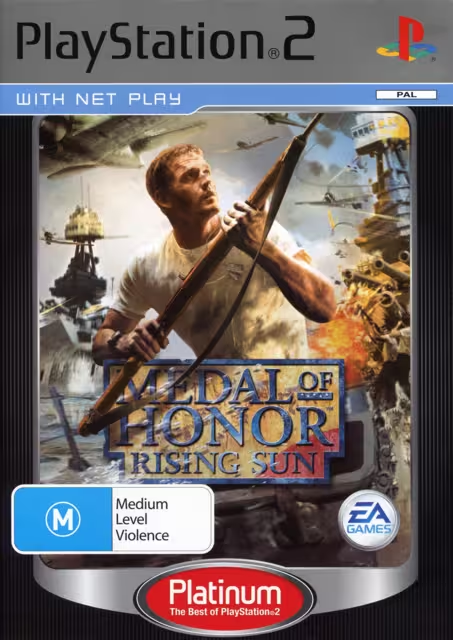
Medal of Honor: Rising Sun (Platinum)
SLES-51873/ANZ/P, DWJ03404472
Video Game Collection


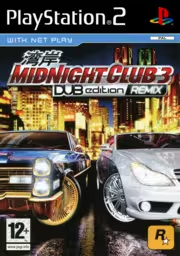 Front Cover
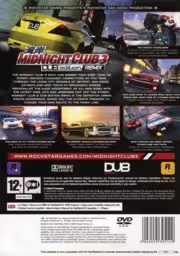 Back Cover
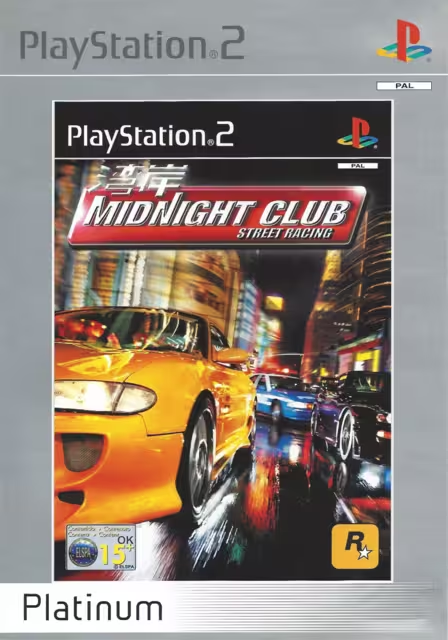
A high-octane masterpiece of urban street racing remembered for its peerless customisation depth, blistering sense of speed, and for being one of the most content-complete definitive editions of the sixth generation.
Midnight Club 3: DUB Edition Remix saw the franchise refine its chaotic, open-city racing formula to its absolute zenith, offering a massive expansion over the original 2005 release. The title captures the height of mid-2000s automotive “bling” culture, moving away from the punishing, clinical difficulty of Midnight Club II in favour of a more accessible, style-focused progression. It reflects a design direction that prioritised licensed authenticity and player expression, serving as a definitive collaboration with DUB Magazine that bridged the gap between hip-hop culture and mainstream gaming during the PlayStation 2’s peak.
The gameplay experience is built around illegal street races across four massive US cities: San Diego, Atlanta, Detroit, and exclusive to the Remix edition, a revamped version of Tokyo. Unlike the rigid tracks of its competitors, the game utilises a checkpoint-anyway system that requires players to memorise city layouts and find their own shortcuts through malls, parks, and alleyways. This iteration introduced a diverse roster of over 80 licensed vehicles, ranging from exotic supercars and tuners to choppers and SUVs. A standout feature is the inclusion of Special Moves like Zone (slow-motion), Agro (ploughing through traffic), and Roar (sending out a shockwave), which added a layer of arcade strategy to the high-speed navigation of dense urban traffic. Notably, the Remix version added 24 new vehicles and 25 additional licensed music tracks, providing roughly 30% more content than the original.
The development saw the team’s mastery of the Angel Game Engine (the tech lineage from Angel Studios and precursor to the modern RAGE – Rockstar Advanced Game Engine ), pushing the PlayStation 2 to its absolute limit. A success was the sense of speed; the game maintains a remarkably stable frame rate despite the high volume of traffic, particle effects, and complex neon lighting. However, the PlayStation 2 version faced significant technical hurdles in the Tokyo maps, where the increased verticality and density occasionally led to texture pop-in and shimmering. Further, the UIs and loading times, while Remix improved asset streaming, the transition from the garage to the open world remained a strain on the console’s bandwidth. The PAL release is also noted for its lack of a native 60Hz mode, which resulted in a slightly slower gameplay feel compared to the NTSC original.
Upon release, Midnight Club 3: DUB Edition Remix received universal acclaim, with many critics hailing it as the premier racing experience on the console. Magazine reviewers lauded the staggering amount of content provided, particularly praising the addition of the Tokyo map and the depth of the visual tuning options. Reception was exceptionally strong globally, with the title quickly becoming the preferred version for both new players and returning fans. Retrospectively, it is the high-water mark of the franchise, with an incredible licensed soundtrack and for providing a sense of urban freedom and customisation that many modern titles still struggle to replicate.
| Item Name |
|
|---|---|
| Item Code |
|
| Item Number |
|
| Series | |
| Type | |
| Genre | |
| Characteristics | |
| Region | |
| Territory | |
| Packaging | |
| Documentation | |
| Developer | |
| Publisher | |
| Media | |
| Players | |
| Peripherals | |
| Video Modes | |
| Sound Modes | |
| Classification | |
| Release Date | |
| Date Added |
|