Sengoku Basara 3
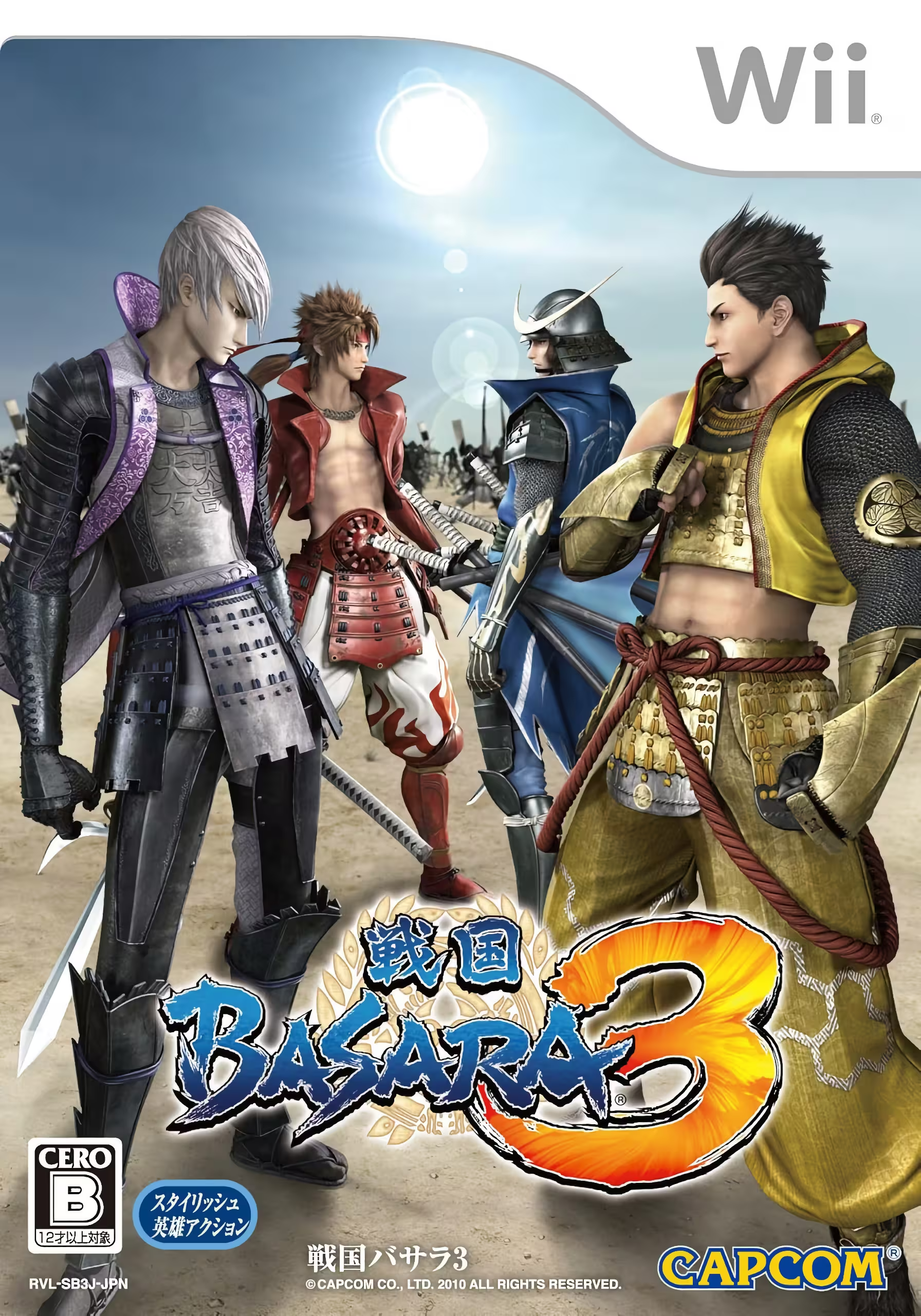
A stylised reinterpretation of Japan’s Sengoku period that merges historical figures with hyper-exaggerated action design, representing the series’ fullest transition into large-scale, spectacle-driven “hero action” on home hardware.
Description
Sengoku BASARA 3 arrived after a four-year gap, providing a significant mechanical and structural evolution to the series. It remains a hack-and-slash action game built around large battlefields populated by dozens of enemies, drawing clear structural parallels to Koei’s Dynasty Warriors formula while pushing further into arcade-style excess. You play as one of several highly individualised samurai, each equipped with unique weapons, movesets, and “BASARA” special attacks, capable of cutting through entire platoons with exaggerated, almost superhuman force. Combat emphasises speed, combo chaining, and crowd control, with encounters structured around defeating large enemy groups, capturing strategic points, and ultimately confronting named commanders.
The game centres on a dramatised interpretation of the lead-up to the Battle of Sekigahara, with Tokugawa Ieyasu and Ishida Mitsunari positioned as opposing central figures. While rooted loosely in historical events, the portrayal is overtly stylised, prioritising theatrical characterisation and spectacle over accuracy. The broader cast, comprising of both returning favourites and newly introduced warriors, spans a wide range of exaggerated personalities and visual designs, reinforcing the series’ identity as “pseudo-history” infused with anime-inspired flair.
The gameplay introduces several new systems that significantly expand its combat depth and pacing. Chief among these is the “Sengoku Boost” mechanic, which temporarily slows enemy movement and enables extended, uninterrupted combo sequences, encouraging aggressive, momentum-driven play. Complementing this are revised skill inputs that allow more abilities to be accessed within a single battle, as well as enhanced “BASARA” techniques that can be upgraded into more powerful finishing moves. These changes collectively push the series toward a more fluid, high-intensity combat loop, closer in spirit to Capcom’s character action titles than traditional musou-style design. Beyond combat, Sengoku BASARA 3 incorporates a stronger layer of battlefield strategy. Stages are divided into “camps” or territories that can be captured and controlled, influencing enemy behaviour and providing buffs such as increased attack power or health regeneration. This system introduces a territorial dynamic to encounters, requiring players to balance direct combat with positional control. Objectives vary between missions, ranging from assassination targets to defensive scenarios, adding structural variety to the core loop.
The released across PlayStation 3 and Wii, being functionally identical in terms of content and design, with the Wii version offering the same core experience through multiple control schemes, including Wii Remote and Classic Controller support. Within the Wii library, it stands apart as one of the console’s more technically ambitious, systems-heavy action titles. The Wii version supports two-player split-screen cooperative play, aligning with the platform’s emphasis on shared experiences, while retaining a substantial single-player “drama” mode that allows players to progress through branching battle routes and character-specific story paths. This structure encourages replayability, with different progression routes leading to alternate stages and narrative outcomes.
At release, Sengoku BASARA 3 was positioned as both a continuation and a reinvention of the series, refining its identity around fast-paced, stylised action and layered battle systems. While a Western localisation as Sengoku BASARA: Samurai Heroes marked one of the franchise’s broader international pushes, the original Japanese Wii release remains emblematic of the musou-scale warfare and unapologetically exaggerated aesthetics.
Datasheet
| Item Name |
|
|---|---|
| Original Name |
|
| Item Code |
|
| Item Number |
|
| Type | |
| Genre | |
| Region | |
| Territory | |
| Packaging | |
| Documentation | |
| Developer | |
| Publisher | |
| Media | |
| Players | |
| Peripherals | |
| Video Modes | |
| Sound Modes | |
| Classification | |
| Release Date | |
| Date Added |
|