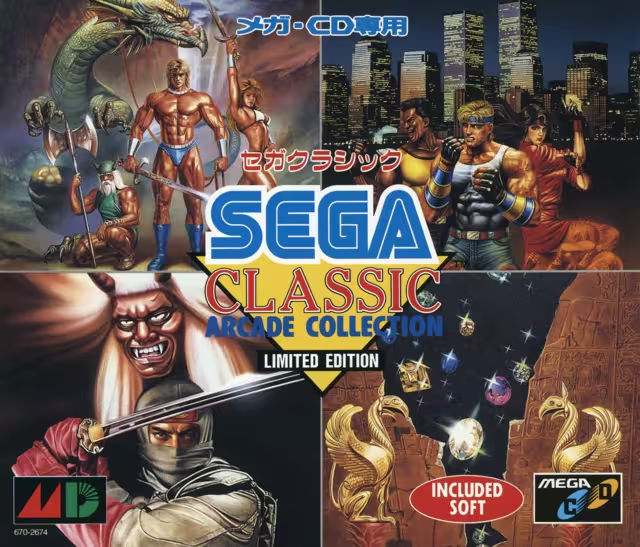
Sega Classic Arcade Collection
G-6012
Video Game Collection

A fast‑paced action platformer adapted from Sega’s 1985 arcade game Teddy Boy Blues. The Master System version strips away the licensed music video tie‑in of the arcade original but retains its core loop of endlessly looping stages, enemy swarms, and time‑based pressure.
Teddy Boy is adapted from Sega’s Japanese arcade game Teddy Boy Blues. Originally it was tied to a J-pop song of the same name by Yōko Ishino (石野陽子) that was removed in the Western version. This is a fast-paced, single-screen platform shooter with a surreal, toy box aesthetic. You control a small boy inside a looping maze, zapping bizarre enemies like dice and lizards before they shrink and scurry away, if they escape, they eat away at your time. Unlike Mario Bros. or Bubble Bobble, Teddy Boy feels more abstract and dreamlike, with its endless, randomised levels and hypnotic pace. It is one of Sega’s quirkier early titles. Despite being less polished than later platformers it had an engaging arcade-loop style.
Players control a boy armed with a rapid‑fire gun, navigating compact, single‑screen stages filled with enemies that emerge from dice‑like boxes. Shooting an enemy shrinks it into a bouncing ball that must be collected quickly; if left too long, the ball turns into a time‑eating bug that reduces the stage timer. Levels wrap around horizontally and vertically, creating a looping arena where enemies can quickly overwhelm the player.
The design emphasises speed and precision. Stages collapse if the player lingers too long in one spot, forcing constant movement. The game features 50 unique rounds that repeat in cycles, with difficulty escalating as enemy speed and aggression increase. The Master System port is faithful to the arcade’s mechanics but presents simplified visuals and a looping chiptune soundtrack that became infamous for its repetition.
Teddy Boy was one of the earliest Master System titles, part of Sega’s effort to bring its arcade catalogue into the home. While mechanically straightforward, it stood out for its relentless pace and looping design, which gave it an almost puzzle‑like rhythm. Reception was mixed: some players valued its challenge and arcade authenticity, while others found its repetition and difficulty spikes frustrating.
| Item Name |
|
|---|---|
| Original Name |
|
| Item Code |
|
| Item Number |
|
| Type | |
| Genre | |
| Theme | |
| Region | |
| Territory | |
| Packaging | |
| Documentation | |
| Developer | |
| Publisher | |
| Distributor | |
| Media | |
| Players | |
| Release Date | |
| Date Added |
|