Crazy Taxi 2
51136
Video Game Collection


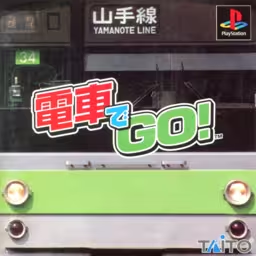 Front Cover
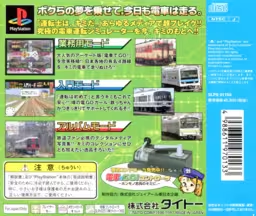 Back Cover
A precision rail operation simulation that emphasises technical accuracy and professional responsibility within a public transport framework. The home ports of the arcade game helped setup what would become a popular series.
Densha de Go! focuses on the daily operations of a professional train driver navigating several of the most famous railway corridors in Japan. The game is driven by the pursuit of operational perfection as the player manages the safety and punctuality of passengers across the Yamanote Line and the Keihin Tohoku Line. It taps into the professional discipline and the rhythmic nature of Japanese urban transit through its detailed recreation of station environments and track side scenery. The atmosphere is one of realism, utilising a clean and functional visual style that replicates the view from a driver’s cab. This release is the first console adaptation of its franchise and was released alongside the dedicated controller peripheral that replicates the physical handles of a real train.
The core gameplay relies on the strict management of acceleration and braking to adhere to a demanding schedule. Players must arrive at stations within seconds of the allotted time and halt the train within centimetres of a specific marker to earn points. A significant technical feature is the three click control system which requires the player to anticipate momentum and environmental factors such as slope and speed limits. The mechanics include penalties for excessive speed, failing to sound the horn at designated points, or using the emergency brake which disturbs passenger comfort. Success is measured by the remaining seconds on a countdown timer that decreases with every operational error. Its popularity spawned a number of similar simulation titles, the most notable was the later Tokyo Bus Annai (1999, Dreamcast), which had a similar emphasis but on the but on the bus network.
Contemporary reviews praised the game for its addictive quality and the high degree of accuracy in its rail data. The transition from the arcade was technically impressive, maintaining the challenging difficulty curve that defined the original experience. The release of the dedicated train controller was highlighted as a major factor in the immersion of the simulation. It became a cornerstone of the Japanese simulation genre and was a major commercial success for the PlayStation. It proved how a niche professional activity can be transformed into a rewarding skill based game, more than a decade before the countless job simulators appear in the West.
| Item Name |
|
|---|---|
| Original Name |
|
| Item Code |
|
| Item Number |
|
| Series | |
| Type | |
| Genre | |
| Theme | |
| Region | |
| Territory | |
| Packaging | |
| Documentation | |
| Developer | |
| Publisher | |
| Media | |
| Players | |
| Peripherals | |
| Launch Price |
|
| Release Date | |
| Date Added |
|