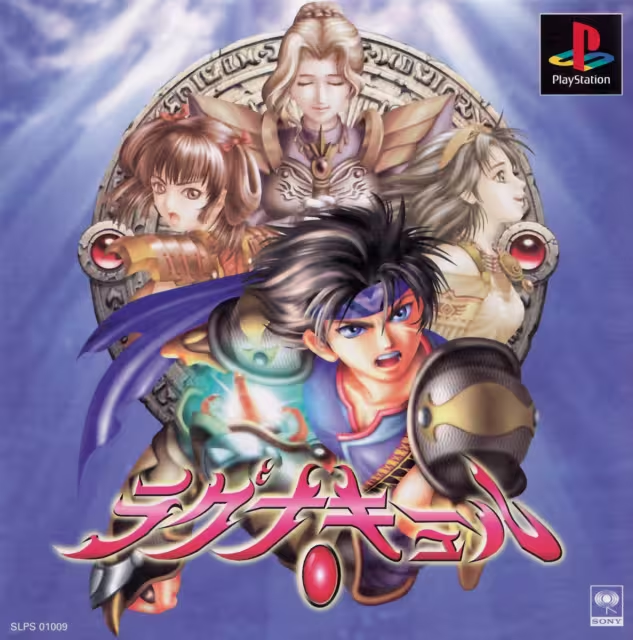
Lagnacure
SLPS-01009
Video Game Collection

An expansive tactical role playing experience that marks the series’ transition into full three dimensional environments and examines the growing political instability of a powerful military empire. Showcased a refined combat framework that emphasises character synergy and the integration of scholastic life with national service.
Eiyuu Densetsu: Sen no Kiseki, known as The Legend of Heroes: Trails of Cold Steel internationally, follows Rean Schwarzer and the members of Class VII as they navigate their inaugural year at Thors Military Academy. Set within the Erebonian Empire, the narrative explores the deep seated tensions between the traditionalist Noble Faction and the rising Reformist Faction led by Chancellor Giliath Osborne. It examines themes of social classism, the loss of innocence in the face of impending war, and the forging of unbreakable bonds across disparate backgrounds. The atmosphere is defined by its cycle of academic study and field studies, moving from the peaceful town of Trista to the industrial and historical centres of the empire. This release serves as the opening chapter of the Erebonia arc, bridging the lore established in the Liberl and Crossbell arcs with the escalating global conflicts seen in Sen no Kiseki II and beyond.
The gameplay relies on an evolved version of the Action Time (AT) battle system, which incorporates battlefield movement with a greater emphasis on tactical positioning. A significant functional addition is the ARCUS system, which allows party members to utilise Tactical Links to perform follow up attacks, provide defensive cover, and share specific combat benefits as their resonance increases. The mechanics feature the return of the Master Quartz system from Zero no Kiseki and expanded in Ao no Kiseki, allowing for deep customisation of character roles through levelling elemental circuits that grant powerful passive and active abilities. Players interact with a structured calendar system that balances dungeon exploration with “bonding events” that influence character relationships and combat effectiveness. The technical framework supports cross save functionality with the PlayStation Vita version, facilitating a seamless transition between home and portable play. It is frequently compared with contemporary Persona titles for its social simulation elements, though it maintains the series’ characteristic focus on dense world building and interconnected narrative history.
Critics at the time of release praised the game for its successful leap into 3D and the high quality of its world building, noting that a vast number of NPCs possessed a unique name and evolving sub plot. Reviewers highlighted the Tactical Link system as a major mechanical improvement that added a new layer of depth to the series’ traditional turn based combat. The decision to ground the massive political narrative in the personal lives of a student cast was commended for making the grand scale of the empire feel intimate and relatable. Retrospectively it is a landmark entry that modernised the franchise for a global audience and established the foundations for its most expansive story arc.
| Item Name |
|
|---|---|
| Original Name |
|
| Item Code |
|
| Item Number |
|
| Series | |
| Type | |
| Genre | |
| Characteristics | |
| Region | |
| Territory | |
| Packaging | |
| Documentation | |
| Developer | |
| Publisher | |
| Media | |
| Players | |
| Peripherals | |
| Video Modes | |
| Sound Modes | |
| Classification | |
| Launch Price |
|
| Release Date | |
| Date Added |
|