Hummer Badlands
SLES-54158
Video Game Collection


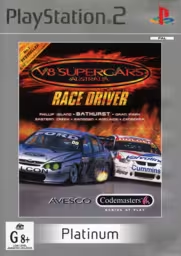 Front Cover
 Back Cover
An ambitious and cinematic leap for the motorsport genre remembered for introducing a character-driven narrative to track racing and for its highly localised global marketing strategy.
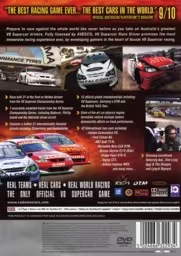
V8 Supercar: Race Driver saw Codemasters aggressively evolve their long-running touring car franchise into a global, story-heavy experience in 2002. The game took a fascinating approach to regional publishing: while it was released in the UK under its traditional moniker TOCA Race Driver, it sold in Germany as DTM Race Driver and North America as Pro Race Driver, the Australian release was specifically rebranded to capitalise on the massive local popularity of the Bathurst 1000 and the Ford-versus-Holden rivalry. The game design prioritises drama and accessibility, moving away from the dry, spreadsheet-heavy progression of pure simulators in favour of a cinematic, television-style presentation.
The gameplay experience is built around the career of Ryan McKane, a hot-headed rookie attempting to climb the global motorsport ranks while grappling with the legacy of his father’s tragic on-track death. Instead of navigating traditional menus, players interact with the game world from a first-person perspective inside Ryan’s office and motorhome, checking emails and receiving reprimands from team managers. While the campaign features 13 global championships (including DTM and BTCC), the Australian version prominently spotlights the V8 Supercar calendar. The driving mechanics strike a balance between arcade forgiveness and simulation weight, requiring players to manage tire grip and momentum while navigating heavily populated, aggressive grids.
On a technical level, the title was driven by the implementation of Codemasters’ revolutionary “Finite Element Method” (FEM) damage engine. This enabled the system’s ability to calculate physical deformation in real-time; rather than swapping to pre-rendered “damaged” models, the cars crumpled dynamically based on the exact angle and velocity of an impact, leading to spectacular, debris-scattering pileups. Like many contemporary titles, the advances came at the risk of its frame rate, which could struggle on the PlayStation 2 when rendering multiple heavily damaged vehicles simultaneously. A major development hurdle involved balancing the game’s tone; seamlessly integrating a full CGI motion-captured storyline with aggressive track physics was an unprecedented challenge for the racing genre.
The game received strong critical praise for taking a massive risk in a notoriously conservative genre. Magazine reviewers lauded the spectacular damage model and the sheer volume of licensed real-world tracks, though the narrative elements were polarising. Many players found the protagonist, Ryan McKane, to be distinctly unlikeable and arrogant. Reception was phenomenally strong in Australia, where the bespoke V8 Supercars branding and the inclusion of local tracks like Adelaide and Phillip Island made it a massive commercial success. Retrospectively, it is viewed as a highly influential title that paved the way for the story-driven modes seen in modern franchises like F1 and Grid.
| Item Name |
|
|---|---|
| Original Name |
|
| Item Code |
|
| Item Number |
|
| Series | |
| Type | |
| Genre | |
| Region | |
| Territory | |
| Packaging | |
| Documentation | |
| Developer | |
| Publisher | |
| Distributor | |
| Media | |
| Players | |
| Peripherals | |
| Sound Modes | |
| Classification | |
| Release Date | |
| Date Added |
|