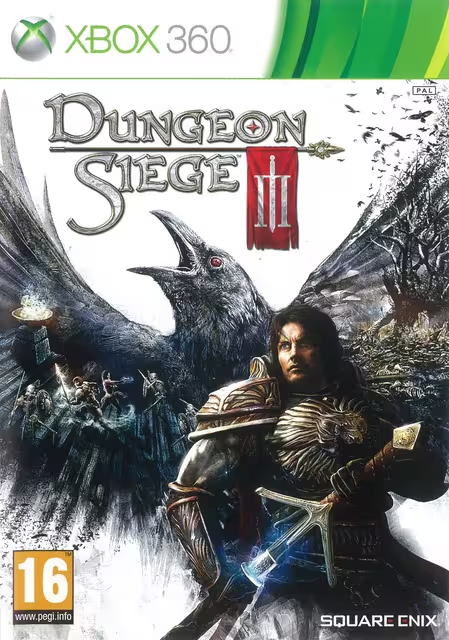
Dungeon Siege III
900-46214
Video Game Collection


 Front Cover
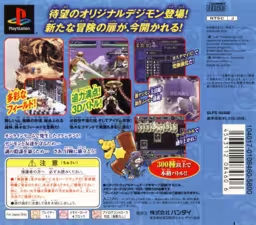 Back Cover
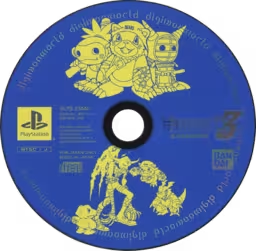 Game Disc
A visually lush JRPG that marked a distinct departure from the series' monster-raising origins, opting instead for a traditional, narrative-driven adventure. It is one of the final major role-playing titles for the PlayStation, pushing the aging hardware to its limits with high-fidelity 2D character sprites set against sprawling, pre-rendered isometric environments.
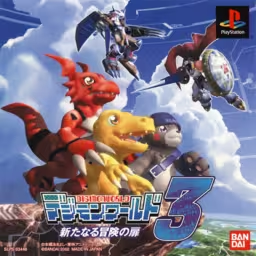
Digimon World 3: Aratanaru Bouken no Tobira (The Door to a New Adventure) released well into PlayStation 2 era. Unlike its predecessors, both the simulation-heavy Digimon World and the dungeon-crawling Digimon World 2 this third instalment adopted the structure of a classic “world-spanning” JRPG. The narrative is set within the fictional “Digimon Online,” a virtual reality MMORPG that becomes a trap for the protagonist, Junior, and his friends. This “game within a game” framing allowed for a vibrant, high-saturation colour palette that stood in stark contrast to the grittier, industrial tones of the previous entries.
The gameplay of Digimon World 3 represents a fundamental shift toward the conventions of contemporary JRPGs, moving away from the simulation-heavy “raising” mechanics of the original title. The experience is bifurcated into two primary modes: field exploration and turn-based combat. During exploration, the player navigates a sprawling isometric world composed of pre-rendered 2D backgrounds and 3D architectural elements, using a localised sprite to represent the protagonist. Unlike its predecessors, which featured real-time movement or grid-based dungeon crawling, DW3 utilizes a traditional overworld and “town/dungeon” structure. Combat is triggered via random encounters and transitions to a dedicated 3D battle arena. This is where the JRPG adopts a monster-duel gameplay. While the player travels with a party of up to three Digimon, the turn-based battles are strictly one-on-one encounters. Players manage their Digimon’s health, mana, and “Digivolution” gauges, with the tactical ability to swap active party members or utilize “Blast Digivolution” when a tension meter is filled. Another significant inclusion is the Card Battle mini-game, which features its own dedicated UI and complex ruleset, this distinct from the real world CCG that was simulated in Digital Monster Card Game. The card game could have been a standalone game and provides a solid distraction from the main quest.
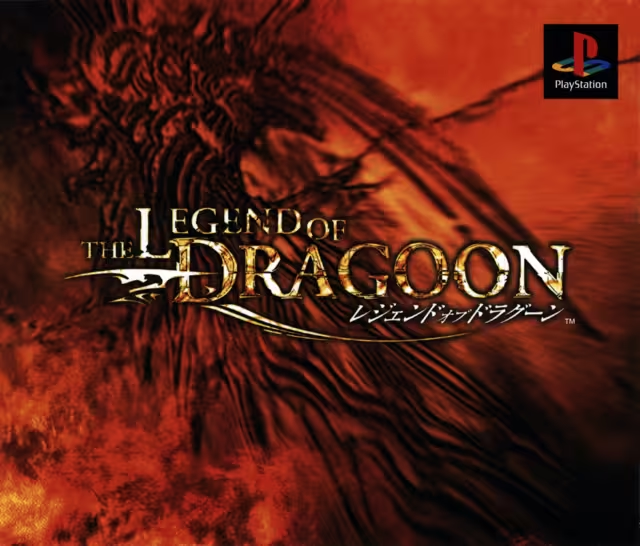
This hybrid structure adopted aspects from the JRPG Golden Era, popularised by Final Fantasy VII and Final Fantasy IX, while also approaching pre-rendered isometric maps and a separate polygonal battle arena inspired by The Legend of Dragoon. Heavily influenced by the competitive “mon-genre” of Pokémon, while offering a deeper, branching evolution system reminiscent of the SaGa and Shin Megami Tensei series. The thematic framing and UI design strongly mirrors the aesthetic of Phantasy Star Online, placing the player within a fictional VR MMORPG to evoke a socially expansive digital atmosphere. Finally, the integrated card battle system provided a secondary gameplay pillar, functioning similarly to the Triple Triad system in Final Fantasy VIII.
Upon its release in Japan, Digimon World 3 was received as a technically accomplished but structurally safe swan song for the PlayStation. Domestic critics, most notably within Famitsu magazine, praised the game for its visual fidelity, noting that the hand-painted isometric environments and high-resolution character sprites represented the pinnacle of 2D artistry on the aging hardware. Reviewers highlighted the game within a game setting of a virtual MMORPG as a clever narrative framework that felt relevant to the burgeoning internet culture of the early 2000s. The inclusion of the “Digimon Card Game” mini-game was also cited as a significant value-add, providing a complex distraction that felt more polished than typical RPG side-activities. Criticism, which was more common in the West, focused on the game’s pacing and technical constraints. Reviewers frequently pointed to the aggressive encounter rate and the significant amount of backtracking required to navigate the world’s interconnected sectors as points of frustration. Some veteran fans in the Japanese community felt the loss of the “V-Pet” raising mechanics, which had defined the Digimon identity since 1997, made the title feel somewhat generic compared to its peers. Furthermore, the lack of the substantial post-game content was notable, something that was significantly added to the PAL (Europe and Australia) Digimon World 2003. Retrospectively the NTSC-J release was a polished, albeit mechanically demanding, farewell to the 32-bit era.
| Item Name |
|
|---|---|
| Original Name |
|
| Item Code |
|
| Item Number |
|
| Series | |
| Type | |
| Genre | |
| Theme | |
| Region | |
| Territory | |
| Packaging | |
| Documentation | |
| Developer | |
| Publisher | |
| Media | |
| Players | |
| Peripherals | |
| Release Date | |
| Date Added |
|