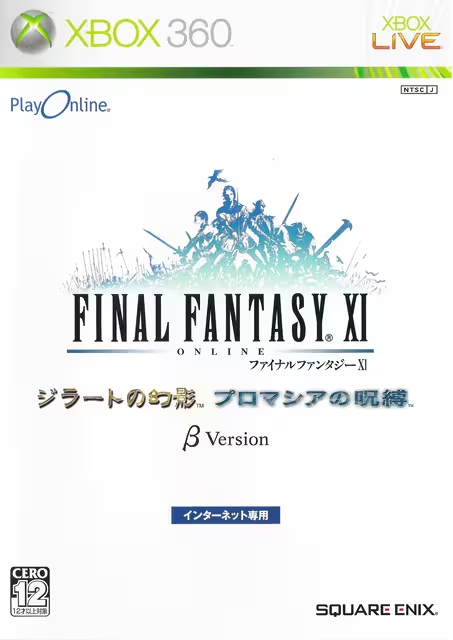
PlayOnline / Final Fantasy XI Beta Version
62F-00001
Video Game Collection


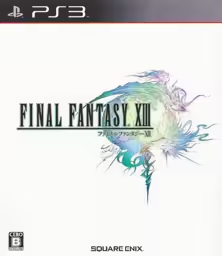 Front Cover
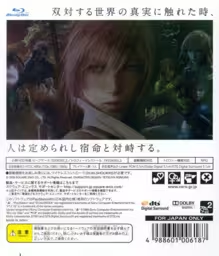 Back Cover
A cinematic role playing experience that serves as a technical showcase for its generation, focusing on a highly stylised and linear narrative structure. Showcased the debut of the “Crystal Tools” engine, delivering a level of visual fidelity and character detail that pushed the boundaries of seventh-generation hardware.
Final Fantasy XIII follows a group of six strangers who are branded as fugitives of the state by a god-like mechanical entity, forcing them into a desperate struggle against fate itself. Set within the floating world of Cocoon and the wilderness of Pulse, the narrative examines themes of predestination, the human cost of divine intervention, and the strength of chosen family in the face of societal persecution. The atmosphere is defined by its pristine, high-tech environments and a fast-paced, rhythmic narrative flow that prioritises emotional momentum over exploration. This release is the cornerstone of the Fabula Nova Crystallis sub-series, establishing a complex mythology that continues through later XIII-2 and Lightning Returns.
The gameplay introduces the Command Synergy Battle (CSB) system, a highly evolved version of the series’ traditional Active Time Battle that emphasises strategic pacing and visual spectacle. A significant functional addition is the Paradigm Shift mechanic, which allows players to instantly change the combat roles of the entire party to adapt to shifting battlefield conditions, such as moving from aggressive offence to dedicated healing. The mechanics feature the Stagger system, requiring players to chain specific elemental or physical attacks to break an enemy’s defence and deal massive damage. Players interact with a character progression system called the Crystarium, a non-linear path of ability and stat upgrades that mirrors the visual style of the Final Fantasy X Sphere Grid. The technical framework is notable for its seamless transition between real-time gameplay and high-definition pre-rendered cinematics. It has similarities with Final Fantasy X for its linear progression and Final Fantasy VII Remake for its hybrid approach to tactical and action-oriented combat.
Critics at the time of release praised the game for its breathtaking visuals and the depth of its revised combat system, which was considered one of the most engaging in the series’ history. Reviewers noted that the focus on a tightly controlled narrative allowed for more intimate character development, though some contemporary critics found the lack of traditional towns and open exploration to be a significant departure from series norms. The musical score by Masashi Hamauzu was highlighted as a major atmospheric success, perfectly complementing the game’s futuristic and melancholic tone. Retrospectively it was a divisive but technically brilliant entry that redefined the series’ aesthetic for the high-definition era.
| Item Name |
|
|---|---|
| Original Name |
|
| Item Code |
|
| Item Number |
|
| Series | |
| Type | |
| Genre | |
| Region | |
| Territory | |
| Packaging | |
| Documentation | |
| Developer | |
| Publisher | |
| Media | |
| Players | |
| Video Modes | |
| Sound Modes | |
| Classification | |
| Launch Price |
|
| Release Date | |
| Date Added |
|