Shenmue
シェンムー

-
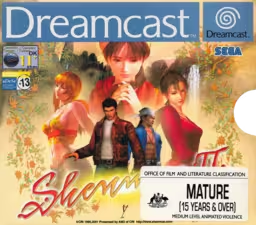
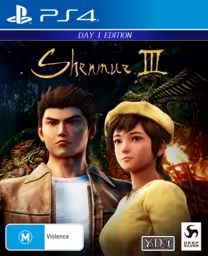
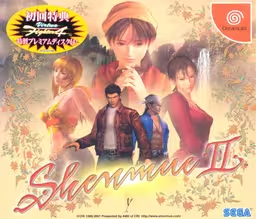
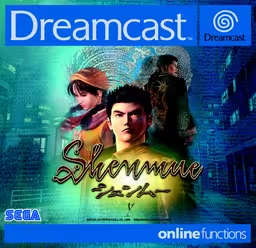 Front Cover
-
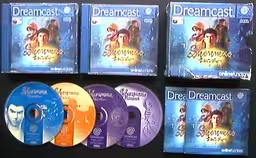 Discset
A revenge story told through the textures of everyday life. Its themes of grief, duty, and time, combined with its meticulous simulation of place, make it one of the most distinctive and influential games of its era.
Description
Shenmue is best understood as a slow, atmospheric epic about grief, revenge, and the rhythms of everyday life, blending martial‑arts melodrama with an unprecedented simulation of 1980s Yokosuka. The first Shenmue follows Ryo Hazuki, a teenage martial artist who witnesses his father’s murder at the hands of Lan Di, a mysterious figure seeking the Dragon Mirror. The game charts Ryo’s obsessive quest for revenge, beginning in his hometown and gradually expanding outward. While the premise is a classic revenge tale, the execution is strikingly different: instead of rushing toward vengeance, the game immerses the player in the mundane details of daily life, from asking neighbours about clues to feeding a stray kitten.
At its core, Shenmue is a hybrid of open‑world exploration, brawler combat, and quick‑time events, but its real innovation lies in its simulation of time and place. NPCs follow daily routines, weather changes dynamically, and shops open and close according to schedules. This creates a sense of lived‑in authenticity, making Yokosuka feel less like a backdrop and more like a breathing environment. The tone is deliberately measured and contemplative. Long stretches of investigation, waiting for buses, or wandering through arcades contrast with sudden bursts of violence. This pacing mirrors Ryo’s emotional state: grief and obsession slow him down, while anger propels him forward. The game coined the term “FREE” (Full Reactive Eyes Entertainment) to describe this blend of interactivity and immersion.
Thematically Shenmue is about loss, duty, and the tension between tradition and modernity. Ryo is caught between his father’s martial‑arts legacy and the encroaching global forces represented by Lan Di and the Chinese underworld. The game’s quiet moments: chatting with shopkeepers, training in the dojo, or watching the weather shift, all reinforce the idea that revenge is not a straight path but a journey through memory, community, and time. The tone is melancholic yet grounded, with a constant undercurrent of inevitability. Even as Ryo pursues answers, the world around him continues at its own pace, indifferent to his quest. This creates a unique tension: the player feels both empowered to act and powerless against the slow march of time.
At release, Shenmue was hailed for its unprecedented realism, environmental detail, and ambition, though its slow pacing and emphasis on the ordinary divided players. Some found its attention to detail revolutionary, while others saw it as tedious. Over time, it has become a cult classic, credited with pioneering mechanics like quick‑time events and open‑world immersion. Even as its controls and voice acting have become a bit dated, this really was a pivotal moment for the industry. It’s difficult to relay the pace of change for those of us who playing the game upon its initial realise. A mere five years earlier we were predominantly still playing 2D games as the 16-bit era ended to suddenly see Shenmue and what all future games could be.
Datasheet
| Item Name |
|
|---|---|
| Original Name |
|
| Item Code |
|
| Item Number |
|
| Series | |
| Type | |
| Genre | |
| Region | |
| Territory | |
| Packaging | |
| Documentation | |
| Developer | |
| Publisher | |
| Distributor | |
| Media | |
| Players | |
| Peripherals | |
| Video Modes | |
| Classification | |
| Release Date | |
| Date Added |
|