Armored Unit
SWJ-SUM003
Video Game Collection


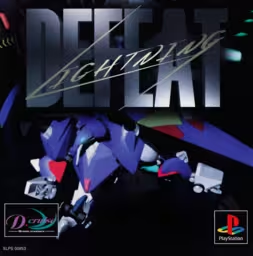 Front Cover
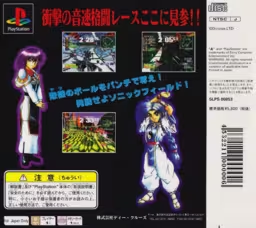 Back Cover
An experimental combat racer featuring wall-climbing robot vehicles and a focus on physical confrontation over pure speed, providing a unique piece of early 3D racing history.
Defeat Lightning is a futuristic combat racing game that is a quintessential example of the cyberpunk racing subgenre that flourished in the mid-90s, aiming to blend the high-speed thrill of Wipeout with more aggressive, vehicle-based combat. While it initially was Japan-exclusive, it was localised years later in Europe as Future Racer published by Midas Interactive.
The gameplay distinguishes itself from traditional racers by utilising six distinct robot vehicles that possess the ability to climb walls, perform vertical loops, and execute devastating blows against opponents. The tracks are designed with significant verticality, often requiring players to transition between ground-based racing and ceiling-running to find shortcuts or avoid hazards. Unlike the sleek, anti-gravity physics of its contemporaries, Defeat Lightning features a weightier, more industrial feel, where the blows you swing at other racers are just as vital to your victory as your positioning on the track. The game offers two primary modes: Training and Story. The Story mode provides a loose narrative framework that contextualises the various races and provides progression as the player overcomes rival pilots. While the production values are more modest than big-budget titles of the era, it is often noted for its unique mechanical gimmicks, specifically the wall-running, which was technically ambitious for the original PlayStation hardware.
Retrospectively, this game is frequently categorised alongside other hidden or niche futuristic racers that populated the NTSC-J library. It is particularly interesting for collectors because the Japanese original maintains a distinct aesthetic identity compared to its later, budget-branded Western localisation. For many, it represents a specific moment in the 32-bit era where developers were experimenting with 3D movement in ways that challenged the standard track-bound racing logic.
| Item Name |
|
|---|---|
| Original Name |
|
| Item Code |
|
| Item Number |
|
| Type | |
| Genre | |
| Theme | |
| Region | |
| Territory | |
| Packaging | |
| Documentation | |
| Developer | |
| Publisher | |
| Media | |
| Players | |
| Peripherals | |
| Launch Price |
|
| Release Date | |
| Date Added |
|