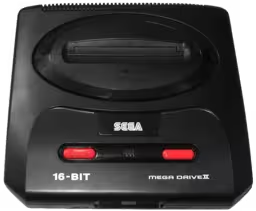
Master System Converter

Sega’s official adapter that allowed the Mega Drive to play the full library of Sega Master System games, both cartridges and Sega Cards, directly on their 16-bit console.
Description
The Master System Converter contains no active hardware of its own; instead, it leverages the Mega Drive’s built‑in Zilog Z80 CPU, SN76489 PSG sound generator, and Master System–compatible video modes. When a Master System game is inserted, the Mega Drive’s bus controller (later integrated into a multi‑function ASIC) switches control from the 68000 CPU to the Z80, effectively turning the console into a Master System. This is similar to how Nintendo provided backwards compatibility on their Game Boy series.
Physically, the Converter is designed to fit over the Mega Drive’s cartridge bay, aligning its connectors to pass signals directly to the console’s motherboard. It routes the Master System’s control, audio, and video lines through the Mega Drive’s existing circuits, with the VDP operating in Mode 4 for SMS graphics output. However, it cannot run SG‑1000 software, as the Mega Drive’s VDP lacks support for modes 0–3.
The Converter’s top slot accepts standard Master System cartridges, while the front slot supports Sega Cards and accessories such as the Sega 3‑D Glasses. A dedicated Pause button is included on the unit because, on the original Master System, pause was a console‑level hardware function rather than a controller input.
Both original Master System controllers and Mega Drive pads are compatible with most games, though certain titles with hardware quirks or region‑specific lockouts may not function correctly. This design allowed Sega to offer seamless backward compatibility without duplicating hardware, making the Converter a cost‑effective bridge between its 8‑bit and 16‑bit ecosystems.
Datasheet
| Item Name |
|
|---|---|
| Item Code |
|
| Item Number |
|
| Quantity |
|
| Type | |
| Class | |
| Territory | |
| Packaging | |
| Documentation | |
| Manufacturer | |
| Distributor | |
| Release Date | |
| Date Added |
|