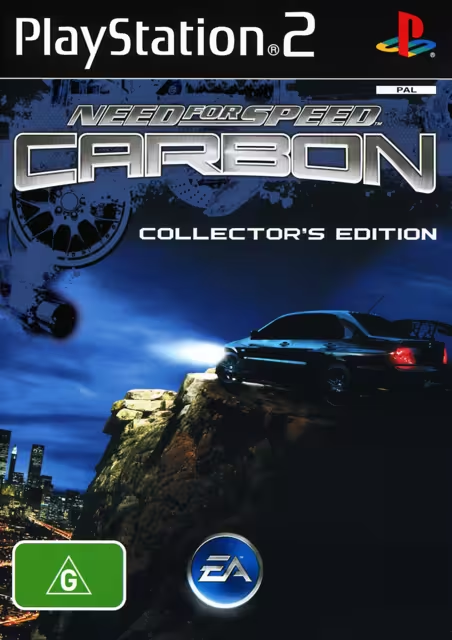
Need for Speed: Carbon (Collector's Edition)
SLES-54492
Video Game Collection


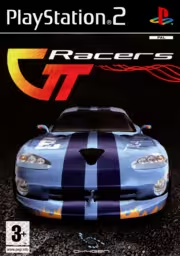 Front Cover
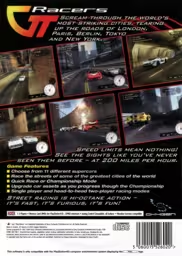 Back Cover
A PAL-exclusive budget racer known for its unlicensed supercar lookalikes and its puzzling restriction to a first-person bumper camera. This copy came in a generic case and might have a replacement cover; disc is legitimate.
GT Racers saw a significant departure from the top-down perspective of its Game Boy Advance namesake, instead attempting to deliver a full 3D arcade racing experience on the PlayStation 2. Developed by the UK-based Aqua Pacific, the title arrived as a budget-conscious entry in a market saturated by high-fidelity simulators. It remains a unique entry that moved away from the complex tuning and licensing of sixth-generation giants like Gran Turismo toward a more accessible, pick-up-and-play format, reflecting the industry’s trend of filling the PAL region’s budget shelves with streamlined genre pieces.
The gameplay revolves around street racing across five global metropolises: London, New York, Rome, Tokyo, and Paris. Each city features two distinct track layouts—one set during the day and another at night—totalling ten circuits. One standout feature is the roster of eleven cars which, while technically unlicensed, are clearly modelled after real-world supercars and luxury models like the Dodge Viper GTS, Bugatti EB110, and Honda NSX. The game is structured around a tiered Championship mode divided into Bronze, Silver, and Gold cups, where players must place in the top three to unlock new vehicle decals and higher-performance machines like the ‘Imperiale’.
The game uses the RenderWare engine, which allowed the team to maintain a smooth frame rate and clean car models despite the game’s budget constraints. A major development hurdle and a frequent point of criticism was the restrictive camera system; despite the manual suggesting otherwise, the game forced players into a bumper-cam perspective for the duration of the race. This was a notable technical compromise, as third-person models for the cars existed, visible during crashes and rear-looking views, but were seemingly disabled for standard driving to preserve performance or simplify the engine’s rendering load. While the sense of speed was commendable for a budget production, the AI pathfinding was rudimentary, often leading to computer-controlled cars sticking rigidly to a single racing line regardless of the player’s position.
The game received a muted reception, with critics identifying it strictly as a no-frills budget title. Magazine reviewers praised the responsive handling and the variety of the real-world city settings but noted that the lack of a third-person camera and the repetitive track design hindered its long-term appeal. Reception was almost entirely confined to Europe and Australia, as the game never saw an NTSC-U release, documenting a period when Oxygen Interactive focused heavily on the PAL territory’s appetite for affordable, high-volume software. Retrospectively, it is a functional but uninspired racer that captures the clones and lookalikes era of the PlayStation 2’s mid-life library.
| Item Name |
|
|---|---|
| Item Code |
|
| Item Number |
|
| Type | |
| Genre | |
| Region | |
| Territory | |
| Packaging | |
| Documentation | |
| Developer | |
| Publisher | |
| Media | |
| Players | |
| Classification | |
| Release Date | |
| Date Added |
|