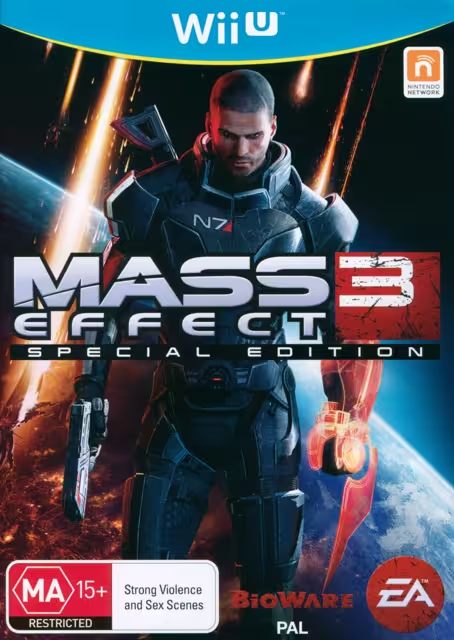
Mass Effect 3: Special Edition
WUP-AMEP-AUS
Video Game Collection


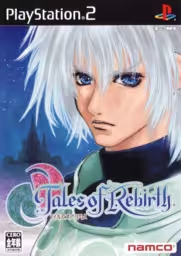 Front Cover
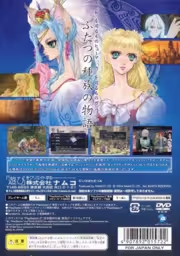 Back Cover
A visually stunning return to the franchise’s 2D roots that served as the official 10th Anniversary title. While it eschews the 3D exploration of its immediate predecessor, it delivers one of the most mechanically complex battle systems in the series alongside a surprisingly mature narrative tackling themes of racial prejudice and coexistence.
Tales of Rebirth arrived in December 2004 serving as the crown jewel of Namco’s 10th Anniversary celebration for the franchise. Releasing a mere three months after the PS2 port of Tales of Symphonia, Rebirth benefited immensely from the aggressive marketing momentum Namco had built throughout the year. Developed by Team Destiny, the internal studio faction dedicated to refining the series’ traditional 2D aesthetic, the game stood in stark contrast to the 3D direction taken by Team Symphonia. By offering a mainline entry completely built around high-fidelity 2D character sprites and beautifully hand-painted backgrounds, Namco catered directly to long-time purists while pushing the PlayStation 2’s hardware capabilities in a highly stylised, traditional direction.
The mechanical centerpiece of Rebirth is its Three-Line Linear Motion Battle System (3L-LMBS), which fundamentally alters the traditional combat flow. Rather than a single 2D plane or free-running 3D space, the battlefield is divided into three distinct horizontal lanes. Players must actively shift between these lines to flank enemies, avoid area-of-effect attacks, and protect their spellcasters. Furthermore, the game famously discards the standard Technical Points (TP) system in favor of the “Force Gauge,” a regenerative meter that requires careful management of offense and healing. This gauge adds a rhythmic, highly tactical layer to encounters, demanding a higher execution barrier than prior entries. The narrative is equally ambitious, following protagonist Veigue Lungberg and exploring the deep-seated political and racial tensions between the human-like Huma and the beast-like Gajuma races. Supported by fluid animated cutscenes from Production I.G and the melancholic opening theme Good Night by Every Little Thing, the presentation is widely regarded as one of the most cohesive and atmospheric in the franchise.
Tales of Rebirth holds a distinct place as a high-water mark for 2D RPGs on the PlayStation 2. Because it was never officially localised for Western markets, the NTSC-J release remains the authentic experience of this specific branch of the series’ evolution. Ultimately, Rebirth represents the pinnacle of Team Destiny’s sprite-work before the inevitable industry-wide shift to full 3D for the subsequent decade, cementing its legacy as a mechanically dense and thematically bold chapter in the franchise’s history.
| Item Name |
|
|---|---|
| Original Name |
|
| Item Code |
|
| Item Number |
|
| Series | |
| Type | |
| Genre | |
| Region | |
| Territory | |
| Packaging | |
| Documentation | |
| Developer | |
| Publisher | |
| Media | |
| Players | |
| Peripherals | |
| Classification | |
| Launch Price |
|
| Release Date | |
| Date Added |
|