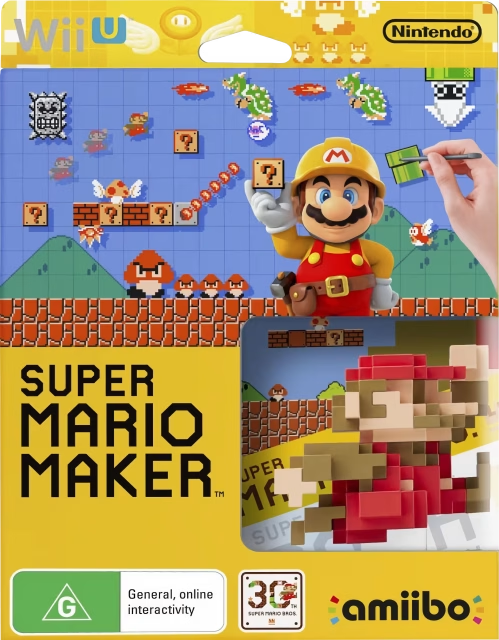
Super Mario Maker (Limited Edition Pack)
WUP-W-AMAP-AUS
Video Game Collection


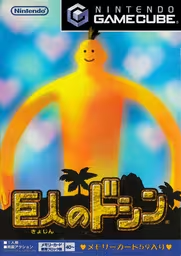 Front Cover
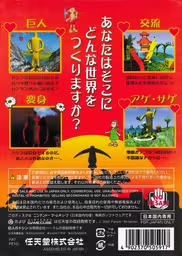 Back Cover
A port of the god‑simulation game originally developed and released for the 64DD. It is often described as Japan’s answer to Populous or Black & White, though with a uniquely whimsical and surreal tone.
Kyojin no Doshin (Doshin the Giant) has a deceptively simple premise: you play as Doshin, a giant yellow figure who emerges from the sea each morning to wander an island inhabited by small villagers. As Doshin, you can reshape the land: raising or lowering terrain, creating mountains, lakes, and plains; and interact with the villagers. Depending on your actions, they will either worship you as a benevolent god or fear you as a destructive force.
The villagers build monuments in response to your behaviour. If you help them, they construct statues of love and gratitude; if you terrorise them, they build statues of fear and anger. Over time, these monuments accumulate, and the island evolves into a reflection of your choices. The game ends when the island is filled with monuments, at which point Doshin disappears back into the sea. Kyojin no Doshin is less about challenge and more about sandbox experimentation. You can grow larger by absorbing villagers’ emotions, which expands your ability to reshape the environment. The GameCube version added extra scenarios and content, but the core loop remained the same.
Visually, the game is bright and minimalist, with a playful art style that contrasts with its philosophical undertones. It explores themes of power, morality, and the relationship between gods and humans, but does so through a quirky, almost childlike lens. This sees it sit conceptually between Populous and Black & White – closer to Populous in its mechanics and closer to Black & White in its tone.
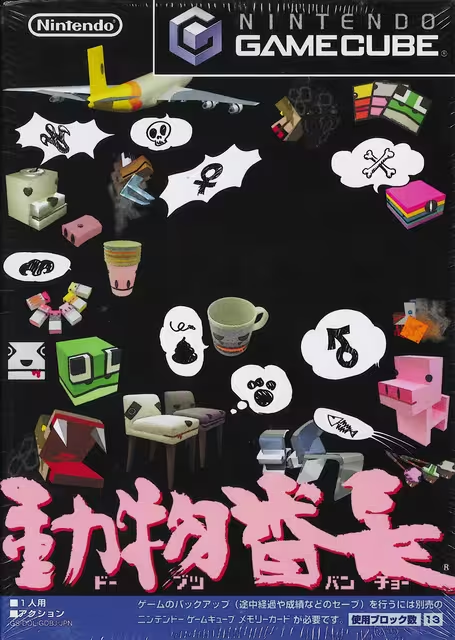
Kyojin no Doshin is significant because it was one of the few titles to fully utilise the 64DD’s capabilities, and its GameCube port gave it a second life outside the poorly distributed add‑on. Plenty of titles were originally planned for the 64DD but ended up on the GameCube, including Dōbutsu no Mori (Animal Forest), Dōbutsu Banchō (Animal Leader), and Biohazard 0 (Resident Evil 0). But Doshin was the only to be released on both.
| Item Name |
|
|---|---|
| Original Name |
|
| Item Code |
|
| Item Number |
|
| Type | |
| Genre | |
| Region | |
| Territory | |
| Packaging | |
| Documentation | |
| Developer | |
| Publisher | |
| Media | |
| Players | |
| Peripherals | |
| Video Modes | |
| Launch Price |
|
| Release Date | |
| Date Added |
|
| External Links |
|