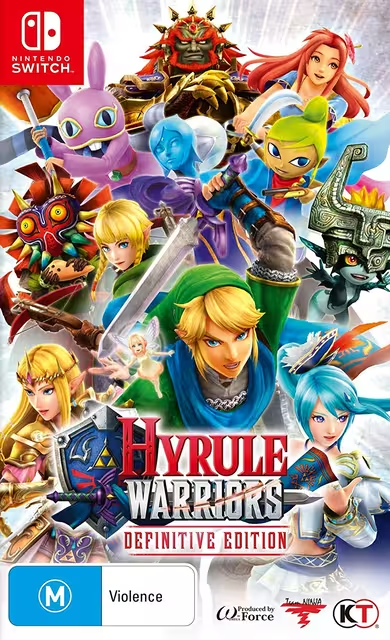
Hyrule Warriors: Definitive Edition
HAC-AK6JA-AUS
Video Game Collection

A vibrant, motion-driven origin story that is memorable for fully realising the 1:1 swordplay promised by the Wii hardware and for establishing the foundational lore of the entire franchise.
The Legend of Zelda: Skyward Sword saw Nintendo deliver one of the final major tentpole releases for the Wii in the later years of its life. Arriving exactly 25 years after the original NES classic, the title reflected Nintendo development commitment to the mandatory use of the Wii MotionPlus accessory. Its design direction that actively pivoted away from the dark, realistic tones of Twilight Princess. Instead, developers opted for a bright, impressionistic watercolor aesthetic, heavily inspired by the works of Paul Cézanne, which allowed the character models and environments to remain expressive and readable despite the ageing, standard-definition hardware. Chronologically, it serves as the earliest point in the Zelda timeline, detailing the forging of the Master Sword and the origins of Zelda, Link, and the eternal cycle of the franchise’s main antagonist.
The gameplay experience is built entirely around directional, 1:1 motion combat. Unlike the simple “waggle” mechanics of Twilight Princess, enemies in Skyward Sword act as physical puzzles; they actively block and parry, forcing the player to swing the Wii Remote precisely horizontally, vertically, or diagonally to break their guard. The core progression relies on navigating between the floating hub-island of Skyloft via a rideable Loftwing, and diving down to three distinct, densely packed surface regions. This entry also fundamentally changed the series’ movement and exploration by introducing a stamina meter, allowing Link to sprint, scramble up walls, and perform parkour-lite maneuvers, a system that would heavily influence the design of Breath of the Wild. Additionally, it introduced an extensive crafting and upgrade system where players collected bugs and monster parts to enhance their shields, potions, and tools.
Upon release, Skyward Sword received massive critical acclaim, earning perfect scores from numerous major publications. Magazine reviewers lauded the emotionally resonant narrative, the incredibly clever dungeon design (specifically the time-shifting mechanics of the Lanayru Desert), and the deeply satisfying, puzzle-like combat. However, the game’s legacy has become notably polarised over time. Retrospective critiques often heavily penalise the game for its over-reliance on Fi’s constant, unskippable tutorials, the repetitive nature of the “Tears of Light” trials, and fighting the Imprisoned boss multiple times. Furthermore, the mandatory motion controls remained divisive for players who preferred traditional button inputs. The later HD remaster on the Switch would address this by ditching most of the motion controls — by then the gimmick had long worn off. Regardless, Skyward Sword is viewed as an absolutely essential, lore-heavy foundation of the Zelda franchise and pillar of the Wii’s catalogue.
| Item Name |
|
|---|---|
| Original Name |
|
| Item Code |
|
| Item Number |
|
| Series | |
| Type | |
| Genre | |
| Region | |
| Territory | |
| Packaging | |
| Documentation | |
| Developer | |
| Publisher | |
| Distributor | |
| Media | |
| Players | |
| Video Modes | |
| Sound Modes | |
| Classification | |
| Launch Price |
|
| Release Date | |
| Date Added |
|
| External Links |
|