Smash Cars
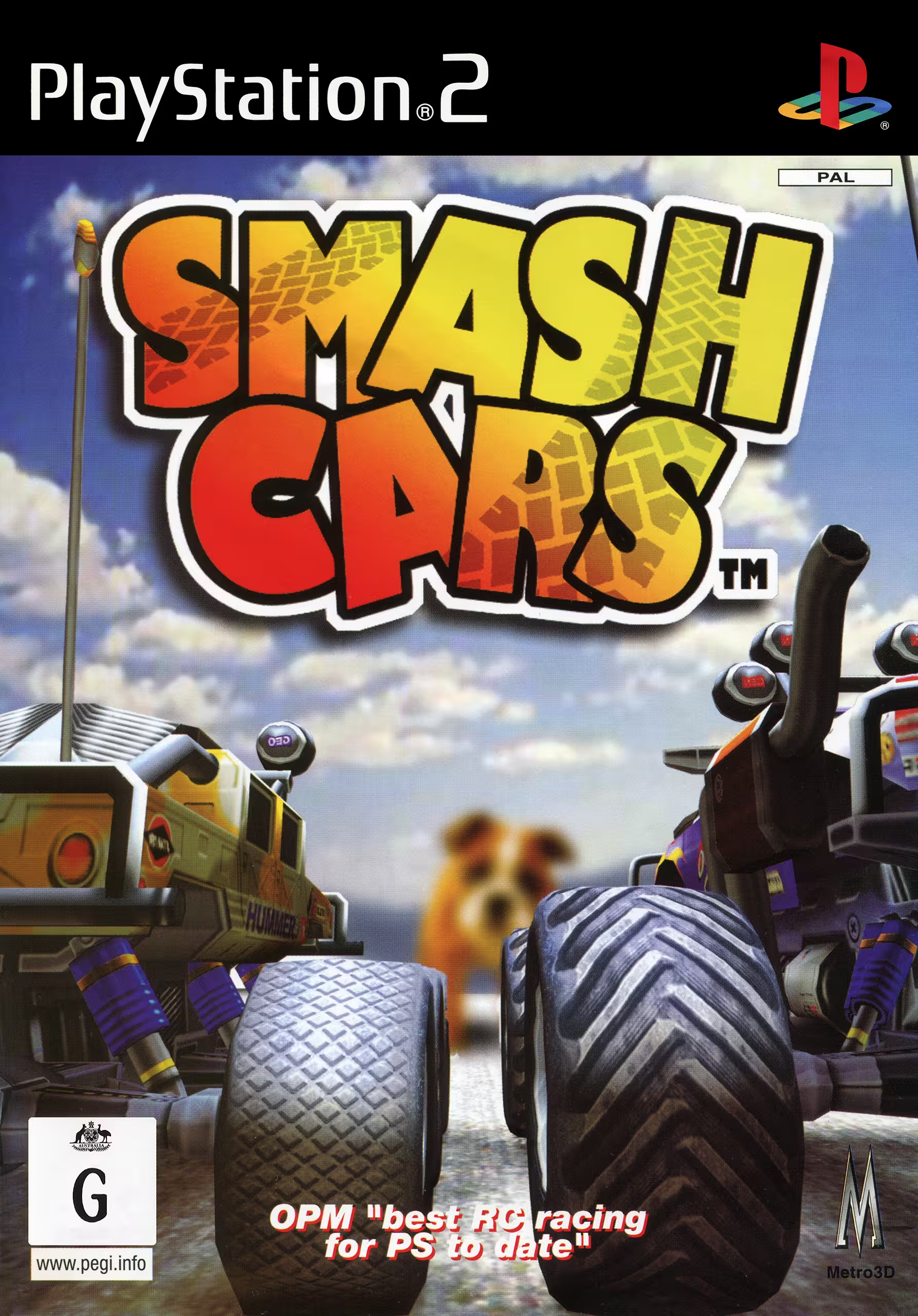
A physics-focused RC racer that traded high-budget visuals for “bouncy” suspension and interactive hazards, remembered for its unique sense of scale and its legacy as a successful budget-to-PSN transition.
Description
Smash Cars saw opts for a physics-driven off-road experience. Originally titled RC Cars, the PlayStation ports were renamed including as Buggy Grand Prix: Kattobi! Dai-Sakusen in Japan. It remains a unique entry that moved the series away from the sterile tracks of traditional RC games toward interactive, real-world environments. Notably this copy does have an Australian-specific cover with different barcode, but still has a PEGI classification printed on it, requiring a last minute sticker on the cover. This may have been due to late local classification. It seems like the barcode was also invalid. Great!
The gameplay revolves around racing radio-controlled buggies through various vacation-themed locales, such as Mediterranean beaches and docklands. Unlike the rigid handling found in many contemporary racers, this title introduced a “bouncy” suspension model that authentically captured the high-centre-of-gravity feel of RC vehicles. A key feature is the integration of human hazards; players must navigate around giant pedestrians, dogs, and beachgoers who can inadvertently kick or stomp the tiny cars. The game is structured around a tiered championship mode where players earn cash to buy engine upgrades and more resilient chassis, alongside a “Stunt Mode” that rewards players for pulling off mid-air flips and rolls.
On a technical level, the development was defined by the team at Creat Studios (based in Russia) and their use of a surprisingly robust physics engine for a budget production. While the game was initially previewed with a target of 60 frames per second, the final release was capped at a stable 30 to accommodate the complex suspension calculations and the high volume of interactive trackside debris. A major development hurdle involved the environmental interaction; the engine had to manage “micro-collisions” with tiny pebbles and uneven terrain that would realistically deflect the lightweight cars. However, this focus on physics led to visual compromises, such as relatively simple texture work and significant “pop-in” for foliage, which critics often noted gave the game a slightly dated, early-generation appearance despite its 2003 release.
Upon release, Smash Cars received a mixed but generally favourable reception, especially given its lower price point. Magazine reviewers praised the “quirky” charm of the RC theme and the surprisingly effective sense of scale, though many noted that the “squirrely” handling could be unforgiving for casual players. Reception was particularly strong in the PAL region, where Metro3D marketed it as a high-value alternative to full-priced racers. While it lacked the polish of its triple-A rivals, the game is retrospectively a cult favourite, remembered for its physics-heavy gameplay and for being successful enough to eventually spawn a high-definition remake for the PlayStation 3.
Datasheet
| Item Name |
|
|---|---|
| Item Code |
|
| Item Number |
|
| Type | |
| Genre | |
| Region | |
| Territory | |
| Packaging | |
| Documentation | |
| Developer | |
| Publisher | |
| Media | |
| Players | |
| Classification | |
| Release Date | |
| Date Added |
|