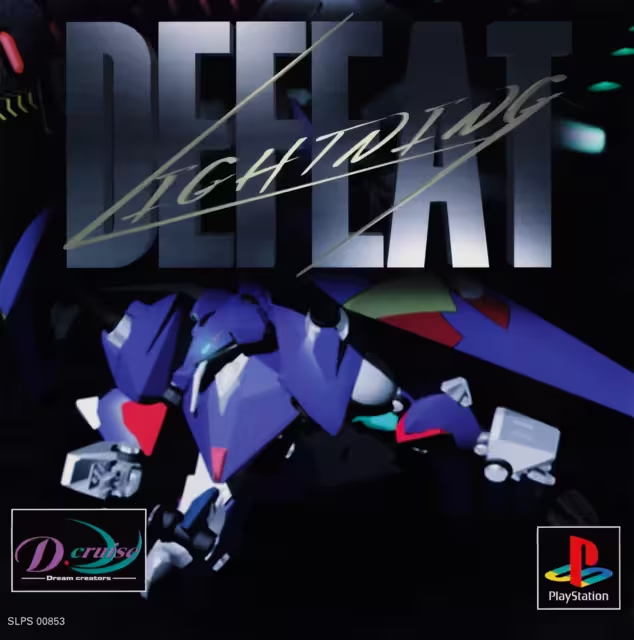
Defeat Lightning
SLPS-00853
Video Game Collection


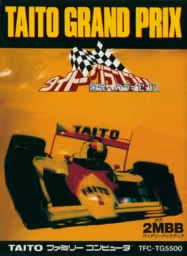 Box Front
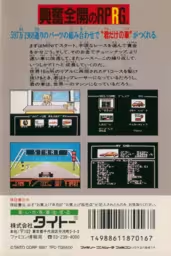 Box Back
A Japan-only racing game released for the Famicom in 1987 that blended arcade-style speed with a career progression system.
Taitō Grand Prix: Eikō e no License (Taito Grand Prix: License to Glory) casts you as an aspiring driver working your way up from local street races to the heights of Formula One glory. In “Normal Mode,” you travel from city to city, earning money through races and gradually building your career until you can compete in a full F1 season. “Open Mode” allows free practice on individual tracks without the career structure. The tone is more simulation-inspired than cartoonish, but still arcade-like in its forgiving physics—cars can flip or crash without taking damage, and the emphasis is on speed and spectacle rather than realism.
Gameplay features over fifteen stock car tracks and eight Formula One circuits, with environments ranging from farms and beaches to stadiums and cities. Cars use manual transmission by default, though automatic can be unlocked in career mode. A notable technical achievement was allowing speeds above 255 km/h, a rarity for 8-bit games due to processor limitations. Players also had the option to “play” cassette-style background music during races, with three selectable tracks, or drive in silence for a more “authentic” feel. Checkpoints extend time in arcade-style races, while failing to reach them results in a game over or financial penalty depending on mode.
Compared to Sega’s World Grand Prix (1986) on the Master System, Taitō Grand Prix was praised for superior graphics and sound on the Famicom hardware. It was part of a wave of mid-’80s racing titles experimenting with career progression, sitting alongside Namco’s Pole Position II and Nintendo’s Famicom Grand Prix series, though it remained Japan-exclusive. At the time the game was appreciated for its variety of tracks and the career structure, though the handling was considered less precise than Sega’s racers. Its ambitious attempt to enhance the classic arcade racer with a proto-career mode would reflect directions in the wider genre years later in franchises like Gran Turismo or Formula 1 on the PlayStation.
| Item Name |
|
|---|---|
| Original Name |
|
| Item Code |
|
| Item Number |
|
| Type | |
| Genre | |
| Color | |
| Region | |
| Territory | |
| Packaging | |
| Documentation | |
| Developer | |
| Publisher | |
| Media | |
| Players | |
| Launch Price |
|
| Release Date | |
| Date Added |
|