Populous

-
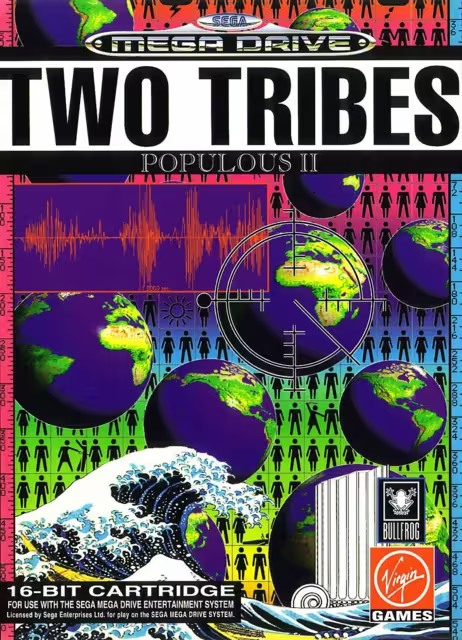
 Front Cover
-
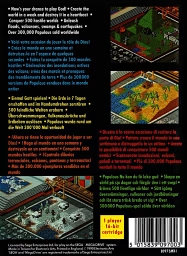 Back Cover
A strategy by way of divine interference, where victory comes not from commanding people directly, but from reshaping the world beneath their feet.
Description
Populous casts the player as a deity locked in opposition with a rival god, guiding a chosen people across harsh, compact worlds until their civilisation is strong enough to wipe out the enemy faithful. Its drama is elemental rather than narrative heavy: mud huts become castles, settlements spread across raised plains, and tiny followers live or die according to the shape of the land. The Mega Drive version keeps that strange moral distance intact, making the player less a ruler than a force of terrain, timing, and punishment.
The gameplay is presented from an isometric view, with the player raising and lowering land to create flat building space, expand settlements, increase population, and build divine power. Mana unlocks interventions such as swamps, earthquakes, floods, volcanoes, and empowered knight figures, while the enemy deity works toward the same territorial chokehold. The cartridge format preserves the famous long-form structure, with hundreds of scenarios built around changing terrain conditions, follower growth, and escalating divine tools, although the joypad interface inevitably makes the landscape work feel more deliberate than on a mouse-driven computer.
Its lineage begins with Bullfrog’s computer original, widely regarded as the first god game and designed by Peter Molyneux with Glenn Corpes, Adrian Moore, Kevin Donkin, and Les Edgar. On the Mega Drive, Populous becomes one of the more ambitious strategy conversions on Sega’s machine, sitting apart from the console’s arcade racers, platformers, and shooters. Compared with later Populous II, it is simpler and sterner, but compared with most 16-bit console strategy titles, it feels unusually abstract, systemic, and self-assured. It was a serious attempt to bring a computer-born strategy classic to a cartridge audience although its limitations are clear today, especially the slower controller-based manipulation and interface density, but its central idea remains sharp.
Datasheet
| Item Name |
|
|---|---|
| Item Code |
|
| Item Number |
|
| Type | |
| Genre | |
| Region | |
| Territory | |
| Packaging | |
| Documentation | |
| Developer | |
| Publisher | |
| Distributor | |
| Media | |
| Players | |
| Release Date | |
| Date Added |
|