D no Shokutaku
Dの食卓
A haunting and pioneering psychological horror ‘interactive movie’ adventure game directed by Kenji Eno. The literal translation is D’s Dining Table, although table is a metaphor for family and secrets. Known simply as “D” internationally, it is a transgressive benchmark for the early 3D era, pushing the storage capacity of optical media to deliver a fully pre-rendered, early example of cinematic storytelling in video games.
Description
D no Shokutaku follows Laura Harris after she receives a call that her father, a respected doctor, has gone on a sudden killing spree and barricaded himself in a hospital. Upon entry, Laura is transported into a surreal, gothic castle that manifests as a physical representation of her family’s dark lineage. The narrative explores themes of cannibalism, reincarnation, and inherited trauma, delivered through sparse dialogue and unsettling visual cues. The atmosphere is one of oppressive isolation, defined by its slow, deliberate camera movements and a minimalist score that heightens the tension of every empty corridor.
Gameplay is a real-time experiment in tension, famously imposing a strict two-hour time limit with neither pause nor save function. Players navigate the environment through pre-rendered FMV sequences, selecting paths and interacting with objects to solve environmental puzzles. Mechanics revolve around a first-person perspective where the player must examine clues, manage a handful of inventory items, and occasionally react to time-sensitive events. Technologically, the game was a powerhouse for its time, utilising high-end Silicon Graphics workstations to create character models and environments that far exceeded the real-time capabilities of home consoles.
This title is the foundational work of the late Kenji Eno and his studio, WARP, establishing a legacy of avant-garde game design that challenged industry norms. While it was originally a flagship title for the 3DO, its successful porting to the Sega Saturn and PlayStation helped define the survival horror aesthetic alongside Resident Evil. The character of Laura Harris would become a digital actress for WARP, starring in the spiritual successor Enemy Zero and the direct, though mechanically different, sequel D no Shokutaku 2 (D2) on the Dreamcast. It remains a singular example of “cinematic” gaming that prioritised the director’s vision over player convenience.
Datasheet
| Item Name |
|
|---|---|
| Original Name |
|
| Item Code |
|
| Item Number |
|
| Series | |
| Type | |
| Genre | |
| Theme | |
| Region | |
| Territory | |
| Packaging | |
| Documentation | |
| Developer | |
| Publisher | |
| Distributor | |
| Media | |
| Players | |
| Classification | |
| Launch Price |
|
| Release Date | |
| Date Added |
|
Related Products
-
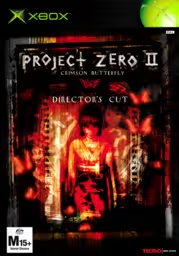 Project Zero II: Crimson Butterfly - Director's CutZJ5-00020
 -
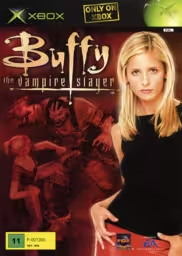 Buffy the Vampire SlayerFXEX7403228
 -
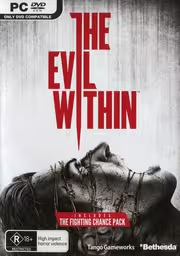 The Evil WithinIL-48178-EAU
 -
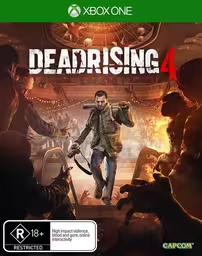 Dead Rising 46AA-00020
 -
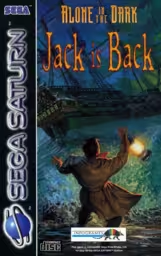 Alone in the Dark: Jack is BackT-15101H-50
 -
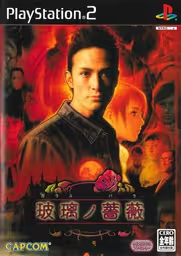 Glass RoseSLPM-65373
 -
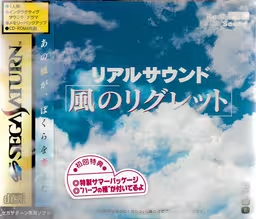 Real Sound Kaze no RegretT-30002G
 -
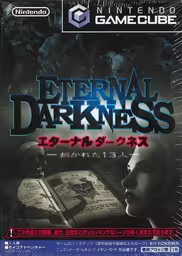 Eternal Darkness: Sanity's RequiemDOL-GEDJ-JPN