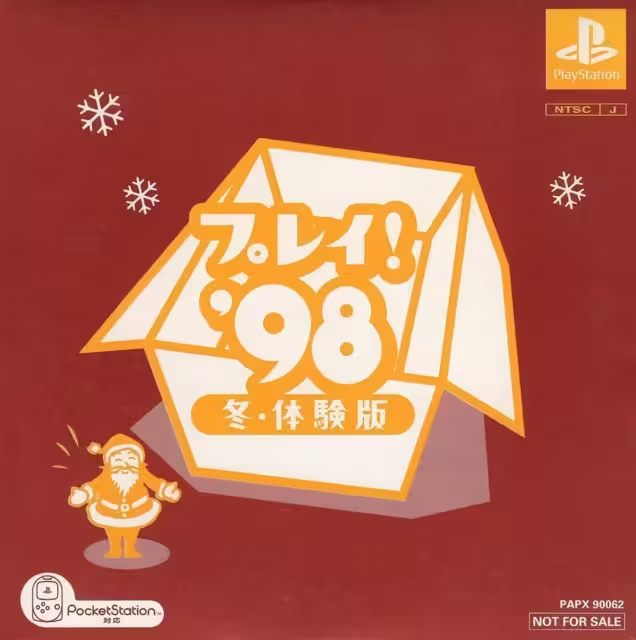
Play! '98 Fuyu Taikenban
PAPX-90062
Video Game Collection


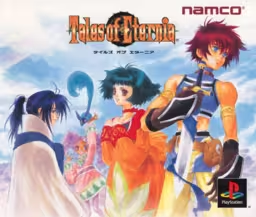 Front Cover
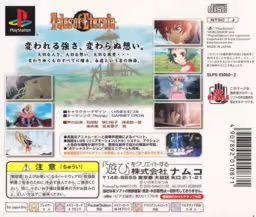 Back Cover
A landmark 2D RPG that perfected the series’ real-time combat and introduced the concept of two interacting twin worlds. A premier technical achievement for the original PlayStation not unlike its series’ genesis.
Tales of Eternia is the third mainline entry in Namco’s long-running RPG series and a technical peak for 2D animation on the PlayStation 1. Spanning three discs, the game follows Reid Hershel and Farah Oersted as they encounter a mysterious girl named Meredy who speaks a foreign “Melnics” language. The plot centers on the impending collision of two twin worlds, Inferia and Celestia, separated by the Orbus Barrier. To prevent the “Grand Fall,” the party must journey between these two contrasting realms: one a lush, traditional fantasy landscape and the other a technologically advanced, storm-swept world, while enlisting the power of elemental spirits known as Greater Craymels. Eternia is notable for adding multiplayer, a first time in the series, supporting up to four players with each controlling a character in the party.
During its contemporary release, the title was widely lauded for its fast-paced Aggressive Linear Motion Battle System (A-LMBS), which significantly increased the combat speed and combo complexity compared to its predecessors. Critics praised the high-quality 2D sprite work and the hand-drawn backgrounds, which served as a vibrant counter-argument to the industry’s aggressive push toward early 3D models. However, the international release was famously complicated by a branding decision in North America to rename the game Tales of Destiny II. While intended to build on the name recognition of the previous Western release, the decision was criticized for creating unnecessary confusion, as the game has no direct narrative connection to the original Tales of Destiny. It was classic western marketing of the era, making terrible decisions. Despite this, the game was a commercial success, selling nearly a million copies and solidifying the series’ reputation for high-budget, anime-inspired production values.
In retrospect, Tales of Eternia is revered as one of the finest 2D role-playing games ever made, effectively perfecting the technical foundation established by the earlier 32-bit entries. Today some may point to it as the gold standard for the franchise’s classic era, specifically for its deep elemental magic system and the introduction of Skits that provided meaningful character development outside of the main script. The naming controversy remains a point of interest, as it eventually led to a situation where the actual sequel to Tales of Destiny (released on the PlayStation 2) remained unlocalised for years to avoid further market confusion (again a slow clap for the marketing infantilising players when they were the brain dead morons). Unfortunately the later PSP port removed multiplayer entirely on a platform that would have really made the most of it. This original 3-disc release is remains a worthwhile experience for its seamless performance, co-operative gameplay, and the density of its side content and mini-games.
| Item Name |
|
|---|---|
| Original Name |
|
| Item Code |
|
| Item Number |
|
| Series | |
| Type | |
| Genre | |
| Region | |
| Territory | |
| Packaging | |
| Documentation | |
| Developer | |
| Publisher | |
| Media | |
| Players | |
| Peripherals | |
| Launch Price |
|
| Release Date | |
| Date Added |
|